
Pip has a four-nail limit. She is four years old, nine pounds, an orange tabby with strong opinions, and somewhere around the fifth nail she decides the whole enterprise is an attack on her dignity. Juniper, my seven-year-old Maine Coon mix, sits through a full set like she is at a cosmetics counter getting her hands done. Same house, same hands, two completely different appointments. That is the thing nobody tells you about cat nail clippers. The tool is maybe a third of the job. The other two thirds are the cat and your own nerves. I have been using the Pet Republique stainless steel clippers on both of them for about six months now, every two to three weeks, and this is what that has actually looked like.
Before these I used a pair of human nail clippers, which split one of Pip's nails and made me feel awful, and a guillotine style that I could never seat straight on a curved cat nail. What I wanted was something small enough to hold in a closed fist while a cat is tucked under my arm, sharp enough that I was not squeezing twice, and steady enough that my hand did not wobble at the moment of the cut. That is a low bar, and most of what I tried cleared two out of three.
The Quick Verdict
Small, sharp, and steady in a fist, with a concave edge that seats a cat nail instead of skating across it. It will not change a cat's mind about trims. It makes the two minutes you get count.
Amazon Check Today's Price →The clipper I reach for every two to three weeks, squirm and all
A concave stainless blade in a body under five inches long, with a grip that stays put when your hand is already tired. Six months on both cats and it still cuts clean on the first squeeze.
Amazon Check Today's Price on Amazon →How I've Used It, Week by Week
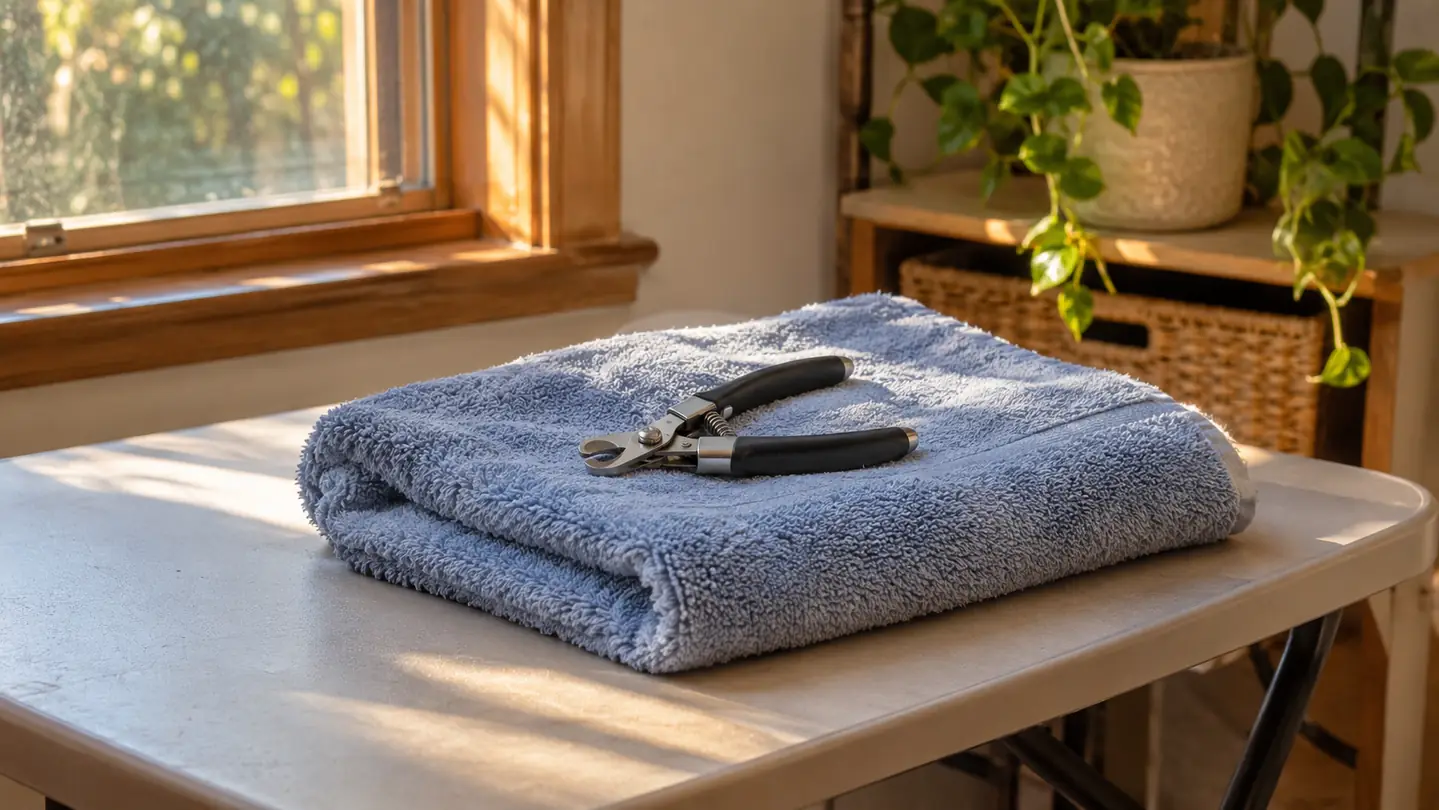
The setup matters as much as the tool. My grooming spot is a folding craft table in the spare room with a bath towel folded double on top, set near the window because both cats would rather look outside than look at me. Nails happen every two to three weeks, usually on a Sunday evening when the house is quiet and nobody has just eaten. The Pet Republique clippers live in the top drawer of that table next to the slicker brush, so there is no rummaging and no warning sound of a drawer being opened in the wrong room.
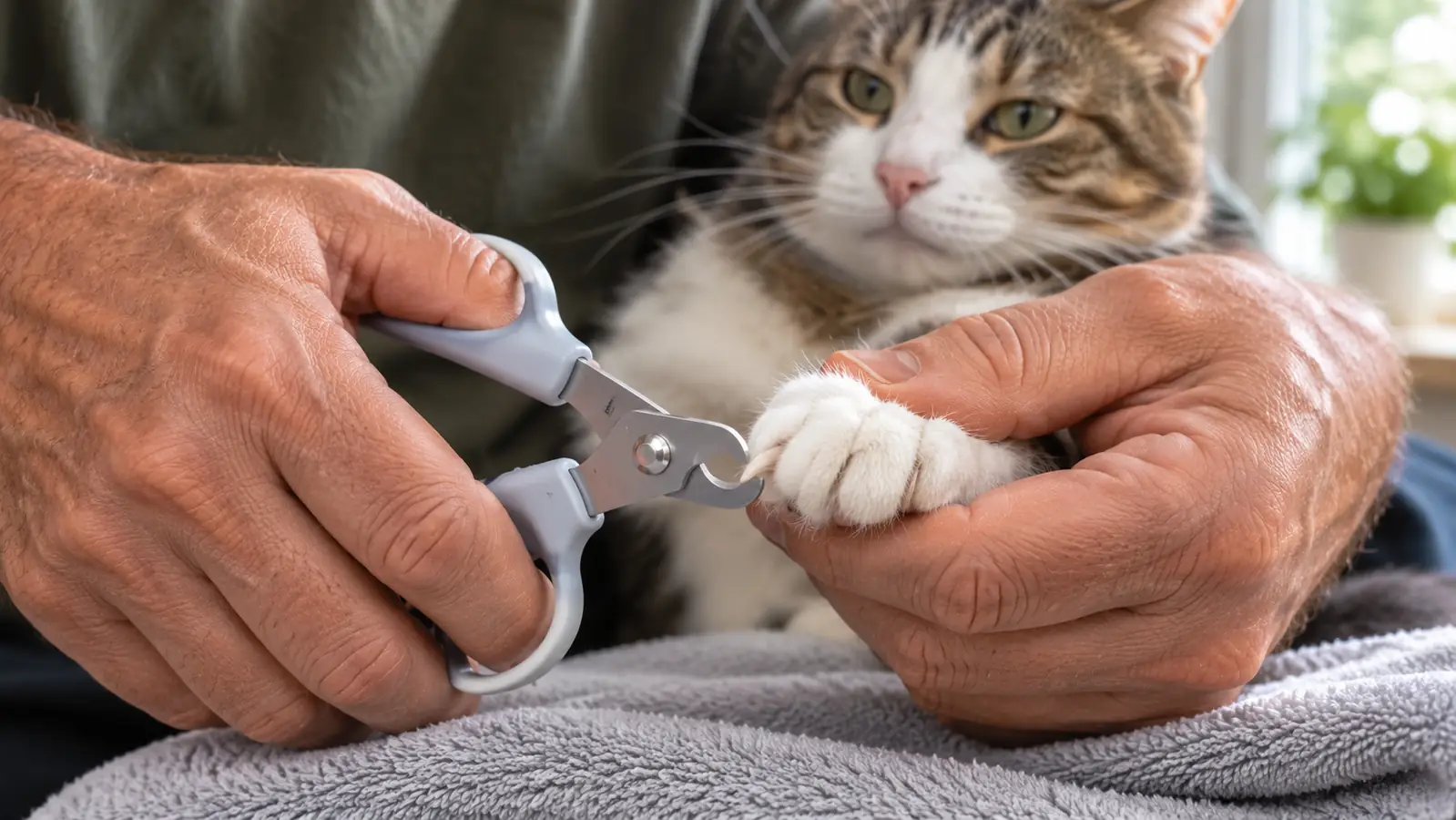
Juniper goes first because she is easy and because Pip watches. I take one paw at a time, press the pad with my thumb until the nail extends, and take the clear hook off the end. The concave blade curves around the nail rather than biting across it flat, so the cut lands where I aimed it. Her nails are thick and noticeably curved, and a straight edge tends to skate before it bites. Four paws, maybe ninety seconds, one treat at the end. Fourteen pounds of calm about the whole thing.
Pip is a different appointment. I wrap her in the towel with one front paw out, do two or three nails, and let her go. Treat. Ten minutes of nothing. Then the other paw, two or three more, treat, release. Sometimes the back paws wait until later the same evening. The clippers being small is the entire reason this works, because I am holding a wriggling nine-pound cat and I need a tool I can work with three fingers while my other arm does the containing.
The first month I did this on the floor, which was a mistake I only understood later. Sitting on the floor with a cat in my lap means I cannot see the nail against anything, and it means the cat can push off with her back legs and get real leverage. The folding table fixed both problems. She is up at chest height, her back legs are supported by the towel, and I am looking down at the paw instead of sideways. It sounds fussy. It cut Pip's fighting in half. The other thing I got wrong early was trying to finish in one sitting. I was treating a partial set as a failure, so I pushed for the fourth nail and taught her that the session only ends when she escalates. Two nails and a release is a better teacher, and it is why the Pet Republique clippers come back out of the drawer the same evening instead of in three weeks.
What the Concave Blade Actually Does
A concave edge is scooped, not straight. A cat's nail is a curved cone, so a flat cut has to be almost perfectly perpendicular or it crushes one side before it severs the other. The scoop seats the nail and cuts around the curve instead of across it. On a cooperative cat the difference is not dramatic. On a cat who moves, it is the difference between a clean cut and a split nail that catches on the rug for a week.
Here is the concrete version. One nail on a front paw, a couple of months in: I had been taking the tip off straight down, and that nail kept catching on the loop of the bedroom rug. The cut end was a small flat disc with a hard edge on one side. When I angled the concave scoop so the curve matched the direction the nail grew, the cut end came out rounded instead. Same nail, same amount off, different edge. That is not cosmetic. A rounded end does not snag, which means she stops yanking her paw back on the rug, which means the next trim is easier for both of us. It also means less time spent on a nail she is already tired of.
The listing suggests a little baby oil on the nail to make the quick easier to see, and I tried it on Pip's darker nails. It does help, though it also makes her paw slippery, so I use the smallest amount and blot the rest. What I rely on more is backlighting. I hold the paw up toward the window and take a thin sliver at a time. Two small cuts beat one confident one when you cannot see the quick clearly.
The blade is stainless and it has held its edge. A dull clipper is worse than a sharp one, because it squeezes before it cuts and the cat feels that squeeze as pressure. That pressure is what teaches a cat to pull her paw back before you have even started. Six months in, most trims still take one clean squeeze per nail. It is the single biggest reason I have not gone looking for something else.
Where It Struggles: The Squirm Factor
These clippers do not fix a cat. Pip still squirms. She still gets three nails in and decides she is finished. No design of clipper changes that, and a review telling you otherwise is selling you something. What a good tool can do is make the window of cooperation count. If your cat gives you thirty seconds, you want a clipper that cuts in one squeeze and is small enough that you are not fumbling while she decides to leave.
The cut is only as steady as your hand. I clipped too close once, years ago, with a different pair, and I have been careful ever since. If your hands shake, or if you are trimming alone and holding a cat who will not be held, the tool is not going to rescue the situation. I still use the towel wrap on Pip every single time, six months in, and I expect I always will.
One session this spring went badly enough that I stopped and put her down. She had something on a back foot, I still do not know what, and the third nail was the end of it. She got a paw free, I flinched, and the clipper closed on air. Nothing was cut wrong and nobody was hurt, but it took three weeks to get her comfortable on the back feet again, and the way back was one nail per evening with a treat, no exceptions. I tell you this because the tool performed exactly as designed that night and it did not matter. When a cat decides the session is over, the session is over.
One more honest note. This is one blade size in one small body. It is sized for cats, kittens, and other small pets, which is exactly right for Pip's nine-pound paws and fine for Juniper's larger ones, but it does not scale up. If you are trimming a big dog's nails, this is not that tool, and the listing is straightforward about aiming itself at cats and small animals rather than at large breeds.
Six Months In: Blade, Grip, and Where It Lives
Six months of use, two cats, roughly every two and a half weeks. That is somewhere north of sixty individual nails, and I have not cut a quick once. The blade is still even. There is no rust on it, which I credit to a dry wipe after each session rather than to anything remarkable about the steel. I keep a cloth in the drawer and give the blade a pass before it goes back, because nail dust and cat hair collect around the hinge.
The grip is larger and softer than the plain metal handles I had before, and it matters most on the last two nails, when my hand is tired and Pip has started thinking about leaving. The Pet Republique clippers are 4.72 inches long and 0.71 ounces, so they disappear into a fist. The tradeoff is that a soft grip gets slick if you have lotion on your hands, which I usually do. I wipe my palms first now. It happened twice before I learned.
It lives loose in the top drawer of the craft table with the slicker brush and the cat wipes, and it has survived that fine. Nothing has loosened. Nothing has needed tightening. For a tool that comes out twice a month and gets used for two minutes, that is exactly what I expected and exactly what I got.
What I Tried Before This
The human nail clippers were the worst of it. They are flat, they are small in the wrong way, and they split a nail on Pip that took weeks to grow out. The guillotine style was better in theory and worse in my hands, because getting a curved nail seated inside a straight ring while the cat is moving is a skill I never developed. Neither one gave me a reason to keep them in the drawer.
For a while I had the vet tech do the trim at the annual visit and then let it slide for months in between. That is not a knock on them. It is that nails need doing every two to three weeks, and a twice-a-year appointment is not that. Home trimming was the only thing that matched the real schedule. What surprised me is that the tool turned out to be the easy part to solve. The handling was the part that took practice.
I also looked hard at the scissor-style pairs, the ones that look like tiny garden shears. A friend who shows cats swears by hers, and I believe her. What stopped me is that scissors need two hands to be steady in a way that a squeeze clipper does not, and I only have one hand free when Pip is wrapped. For the same reason I ruled out a grinder before I ever tried one. The noise alone would end the session, and I am not spending on a tool that gets refused before it touches a nail. That narrowed things down to a squeeze clipper, and to one small enough to hold in the hand that is not holding the cat.
What I Liked
- Concave blade seats a curved cat nail, so the cut lands where you aimed instead of skating
- Under five inches long and under an ounce, easy to work with three fingers while your other arm holds the cat
- Larger, softer grip than a plain metal handle, which helps on the last two nails of a session
- Stainless blade still cutting in one squeeze after six months of twice-monthly use
- Sized for cats, kittens, and other small pets, so it fits a nine-pound tabby paw without feeling oversized
Where It Falls Short
- Does nothing about a cat who will not be held. Pip still needs a towel wrap every single time
- One blade size only, so it is not a large-dog tool
- The soft grip gets slick if your hands are lotioned, so wipe your palms first
- It cannot show you where the quick is. That part is still on you and your backlighting
Six months, two cats, somewhere past sixty nails, and I have not cut a quick once.
Who This Is For
This is for the person doing nails at home every couple of weeks, on a cat who will tolerate being held for thirty seconds if the tool cooperates. It suits a two-cat household where one sits still and one does not, because the same clipper handles both without changing your grip. It is also a good first pair if you have been using human clippers, which is a mistake I made for two years longer than I should have. And it fits rabbits, guinea pigs, and other small pets, since the small body is the point.
Who Should Skip It
Skip it if you want a tool that calms a cat down, because no clipper does that and this one does not pretend to. Skip it if you are not going to trim every two to three weeks, since a monthly session on overgrown nails is harder on everyone and the tool will not compensate. Skip it for a large dog. And skip it if you already know you want a grinder or a scissor-style pair, because this is a straightforward squeeze clipper and it does not try to be anything else. If you want the thing that makes the thirty seconds you get count, this is that thing.
If your cat gives you thirty seconds, make them the right thirty seconds
Concave stainless blade, a body under five inches, and a grip you can hold with three fingers. Six months in on my two cats and it is still cutting clean on the first squeeze.
Amazon Check Today's Price on Amazon →