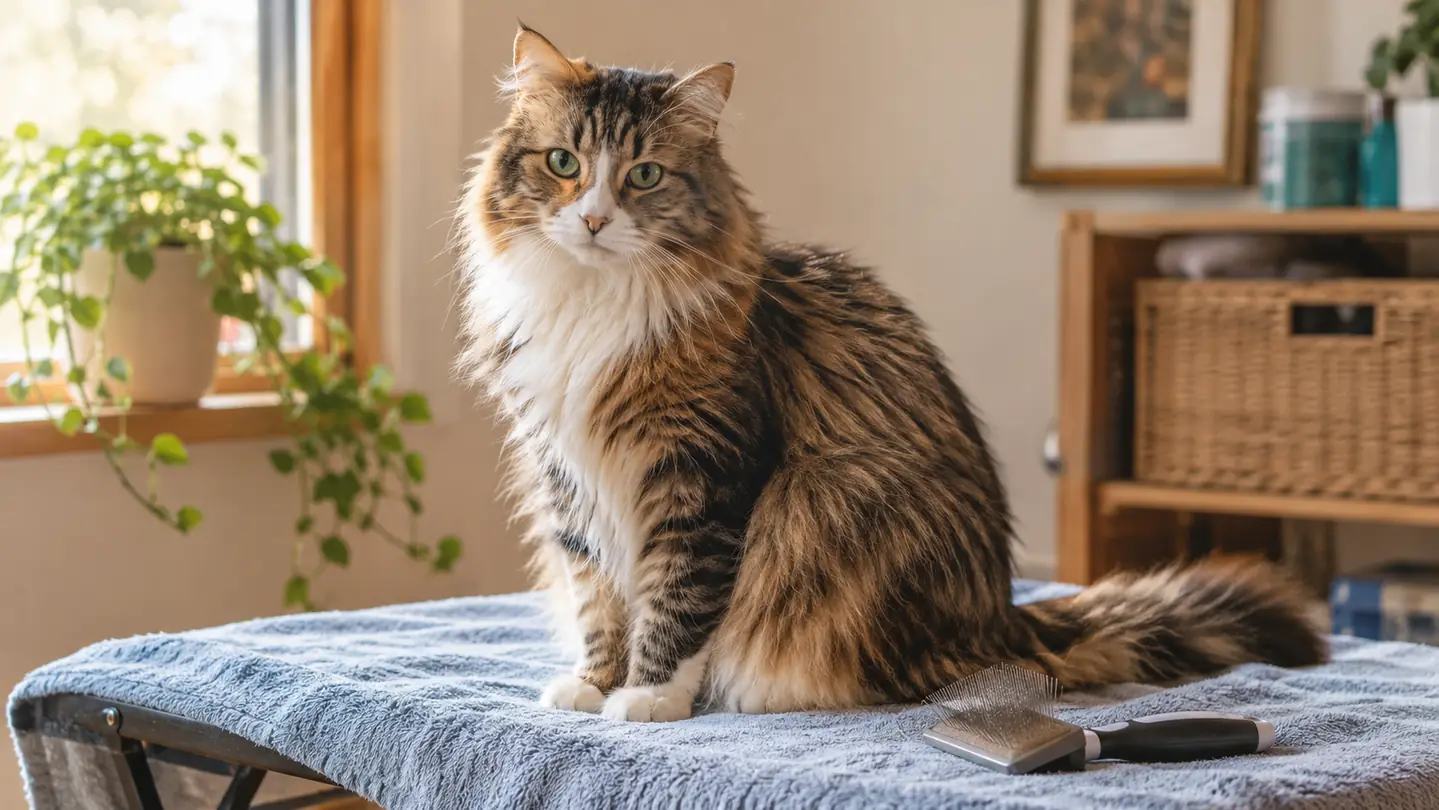
Juniper is seven years old, fourteen pounds, and roughly sixty percent fur by volume. She is a long-haired Maine Coon mix, which means the coat does not fall off politely. It comes off in tufts that drift across the living room floor like small gray weather events, and it gathers behind her ears and along her back legs in soft clumps that turn into mats if I ignore them for a week. I tried three brushes before this one. A fine-toothed comb she tolerated for about forty seconds. A rubber curry tool that mostly moved hair from her back onto my shirt. A slicker with short plastic-tipped pins that never reached under the topcoat. The Aumuca Cat Brush is the fourth, and the only one that still lives in the top drawer of my craft table instead of a donation box.
I have used it for about eight months now, most evenings, on Juniper's back, sides and hindquarters. On Pip, my four-year-old orange tabby who sheds less and has strong opinions, I use it once a week, lightly. Eight months is long enough to know what a brush does well and where it quietly gives up, which is the part most reviews skate past.
The Quick Verdict
The only brush in my drawer that gets under Juniper's topcoat without raking her skin. Worth it if your cat sheds in tufts and will sit still for five minutes. It is not a mat remover, and it will not fix a cat who hates being touched.
Amazon Check Today's Price →If your cat sheds in tufts, this is the one I actually reach for
Eight months of near-nightly use on a long-haired coat. The one-click release dumps the pad in about four seconds, which is why the brush stays in the drawer instead of the donation box.
Amazon Check Today's Price on Amazon →How I've Used It
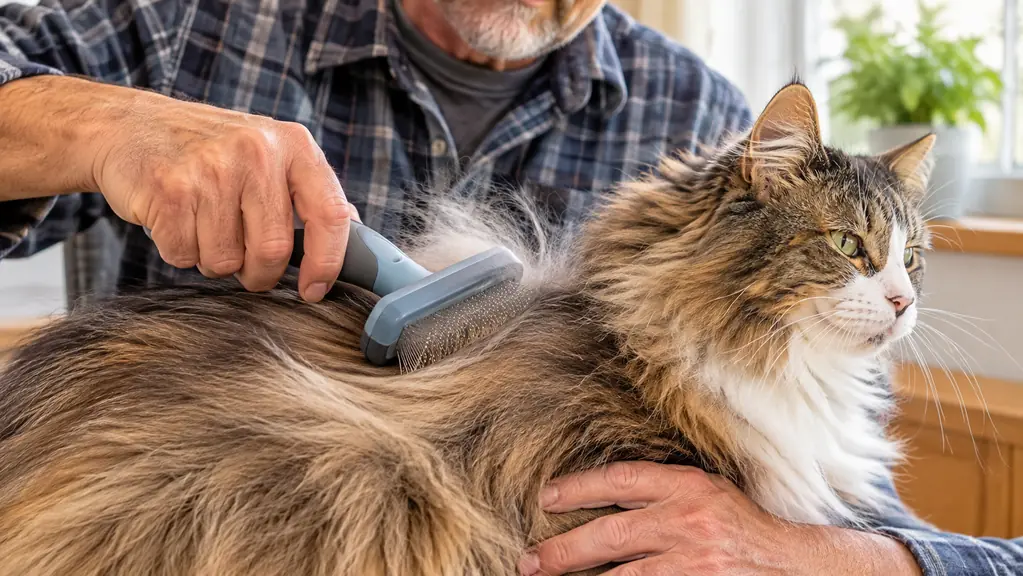
Juniper gets brushed most evenings for five or six minutes. The setup matters more than people think, so here is mine: a folding craft table in the spare room, a bath towel over it, and the table pushed close to the window. She sits because the window is where the birds are, and she will forgive almost anything if there is a bird. I start at her shoulders and work back in short strokes, following the direction the coat grows, lifting the brush at the end of each stroke so the hair comes off the pins instead of being pressed back into the coat.
She gives me a shoulder, a flank, and one hindquarter before she stands up and walks off. I do not chase her. A cat who leaves on her own terms comes back the next evening. A cat who is held down does not, and I learned that the expensive way with the first three brushes. Pip gets a once-a-week pass, usually Sunday, usually while he is half asleep on the arm of the couch. Short-haired cats are easier but they are not free. He carries a dense undercoat along his spine that comes out in a soft felt sheet if I let it go too long. Three passes and I have a palm-sized wad of fur.
Timing is the other half of it. I brush Juniper after dinner, once the kitchen is quiet and the dishwasher has stopped, because a cat who is already relaxed stays relaxed. If I try at seven in the evening when the house is loud and someone is at the door, I get about ninety seconds and a tail flick. Same brush, same cat, different moment. That is not a product thing, it is just how cats work, and no brush on the shelf changes it.
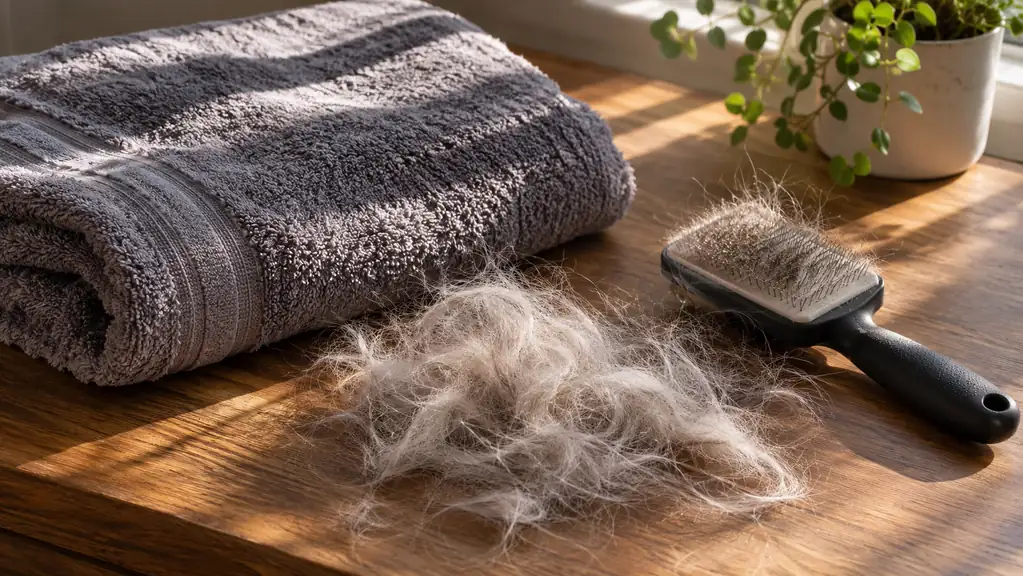
One evening in early March I kept a tally out of curiosity. Six minutes on Juniper produced a pad worth of undercoat about the size of my palm, and when I emptied it and went back over the same three areas I got maybe a third of that again. The second pass is the one that matters most, because a stroke pulls loose fur up to the surface and a single pass only gets what was already sitting there. I finish with two flat strokes down each hind leg, where the fluff grows in every direction at once and the brush has to be angled to catch any of it. That is the whole routine. About a hundred and eighty seconds of brushing and four seconds of clicking.
Cleaning is the part I did not expect to care about. After each session I click the button on the handle, the pins push back, and the collected hair slides off the pad in one piece into the trash. That is maybe four seconds of my evening. During a heavy shed week I empty it twice mid-session, because a packed pad stops grabbing and starts skating over the coat. A full pad is the number one reason people think a brush has stopped working when it has not.
The 150 Degree Bent Pins, and Why It Matters
The listing describes 150 degree bent needles, which sounds like catalog filler until you use them. The bend is what lets the pins slide under the topcoat and catch the loose undercoat without the tips driving straight down into skin. Each pin ends in a small round rubber tip. That tip is the reason Juniper tolerates a five-minute session instead of a forty-second one.
My old slicker had short straight pins. It pulled hair, but every stroke ended with the skin twitching along her spine, and after two minutes she was gone. The bent pins glide at an angle instead of raking. I noticed on the first evening, mostly because she did not leave. By the end of the first week she was staying for the full session, and by the end of the month she was walking onto the towel herself.
I also tested it by accident one night. I had left the Aumuca brush in the other room and used the old slicker on her left side out of sheer laziness. She let me do it for about a minute, then turned around and bit the brush, which she had never done before. I fetched the right one, went over the same patch, and she settled again. Same cat, same coat, same evening, four feet apart on the same towel.
The rest of the build is plain but sound. Stainless steel pins set into a round head, a plastic handle, 5.6 ounces overall and about 8.5 inches long. That weight matters more than it sounds like it should. I can hold the brush in one hand and a treat in the other, and my wrist is not tired after a long-haired session. A heavier brush would have me doing fifteen minutes instead of five, which in practice means I would do it twice a week instead of nightly.
What It Does Not Do
It does not remove a mat. Juniper gets small tight mats behind her ears, and the brush will ride right over the top of one and leave it exactly where it was. When I find a mat I work it apart with my fingers first, a little at a time over a couple of evenings, and then brush the area afterward to smooth the coat flat. A tool that claims to dissolve a mat on its own is usually just pulling it harder, and pulling a mat hurts. If mats are your main problem, buy a comb and set aside the time.
It is not a face and belly brush. The head is wide and round, which is exactly what makes it fast over a back and useless on a chin. Juniper does not want her belly brushed by anything and I do not push it. For her face and chest, and for Pip on the evenings he refuses to sit still for a brush, I use a pair of grooming gloves and just pet them both. It is slower and it picks up less, but it gets done without a wrestle, and Pip thinks he is being adored rather than groomed.
And it does not work on a cat who will not be touched at all. No brush does. If your cat bolts at the sight of a grooming tool, the tool is not the problem and a different tool will not be the fix. That is a slow desensitizing project or a conversation with a groomer, not a purchase.
The brush does not stop the shedding. It moves the shedding from my floor onto a pad I can empty into the trash in four seconds.
The Coat After Eight Months
The honest before and after is smaller than the marketing suggests and bigger than nothing. The living room floor still collects fur. It collects less of it. I vacuum on the same schedule and the canister fills with more actual dirt and less cat hair, which is a strange thing to feel quietly proud of on a Saturday morning.
Her coat feels different under my hand, slicker and flatter, especially along the back legs where the fluff used to stick out at angles. The mats behind her ears still come back, because mats always come back on a coat like hers, but they are smaller now and I catch them earlier. Catching them earlier is most of the battle.
Here is the concrete version, since vague before-and-afters are useless. The mat behind her left ear used to be about the size of a pea and I found a new one roughly every ten days. Now it comes in at half that, and I find one about every three weeks, usually when I am doing her face with the gloves. The little felt beads that used to form along her back legs are mostly gone. What replaced them is a coat that lies flat when I keep up with the evenings and does not when I skip four days in a row.
What it has not fixed: she still sheds. In late spring she blew her coat for about a week and I brushed her twice a day and still found tufts in the hallway. That is a cat, not a brush problem. Anything promising an end to shedding is selling you something that does not exist, and I have bought two of those already.
What Surprised Me After the First Month
The biggest change was not on the floor. It was that Juniper started showing up. Around eight in the evening she began walking into the spare room and sitting on the towel before I had even picked the brush up. I did not train that and I am not going to pretend I did. What I think happened is that the sessions stopped being unpleasant, so they became part of her evening instead of an interruption to it. A cat who is not being raked will volunteer.
The second surprise was how much the emptying button changed my habits. My old slicker needed the hair pulled off the pins with my fingers, which meant a slightly disgusting minute at the end of every session and hair stuck to my hands. I used to skip sessions to avoid that minute. Four seconds of clicking is nothing, so I stopped skipping. A tool that removes its own friction gets used, and a tool that gets used is the only kind that works.
How It Compares to the Three I Tried Before
The comb was the cheapest and the least useful for us. Fine teeth on a long coat just skate across the surface unless you section the hair first, and sectioning a Maine Coon mix on a Tuesday evening is a younger woman's game. The rubber curry tool was pleasant for her and did almost nothing for the floor. The slicker with the short plastic-tipped pins came closest, and it worked right up until it started to feel like a fight.
The difference with the Aumuca brush is not that it grabs more. It is that it grabs more without her noticing. That single change is why I use it nightly instead of grudgingly, and a brush you actually use beats a better brush you avoid. I set it next to the old slicker for a few weeks to be fair about it. The slicker has been in the drawer ever since, and I have not missed it once.
I keep the old slicker for exactly one job now, which is nothing, honestly. It sits in the drawer underneath the Aumuca brush, flat against the wood, and I have not reached for it since the spring.
What I Liked
- 150 degree bent pins reach the undercoat without raking the skin
- Round rubber tips on the pin ends mean a long-haired session lasts five minutes, not forty seconds
- The one-click release empties the pad in about four seconds, so there is no reason to skip a session
- 5.6 ounces and about 8.5 inches long, so one hand holds the brush and the other holds a treat
- Works on a short-haired coat too, in a light once-a-week pass
Where It Falls Short
- It will not touch a real mat, and you should not ask it to
- The round head is too wide for faces, chins and bellies
- The pad packs fast during a coat blow, so you empty it mid-session
- The plastic handle feels light in the hand, though it has held up for eight months
- If your cat will not sit for a brush at all, this is not the tool that changes that
Who This Is For
Cat owners with a long-haired or double-coated cat who sheds in tufts and will sit for a few minutes on a table or a couch arm. People who already brush regularly and want to stop fighting the brush every time. Owners of short-haired cats who want one pass a week instead of a lint roller and a hopeful attitude. If you have been through two or three brushes and none of them ever reached the undercoat, this is the next one I would try, and I would try it for a full week before deciding.
Who Should Skip It
Skip it if your main problem is mats, because you need fingers, a comb, and patience, not a slicker. Skip it if your cat will not be handled at all, since gloves or a professional groomer are the better next step. And skip it if you want a brush that ends shedding, because nothing on this shelf does that. All this one does is move the hair from your floor onto a pad, quickly and without a fight, which after eight months is the only promise I needed kept.
Eight months in, it is still the brush in the drawer
If your cat sheds in tufts and tolerates a few minutes of brushing, this is the one I would buy again. If mats are the issue or your cat will not be touched, spend the money on a comb and some patience instead.
Amazon Check Today's Price on Amazon →