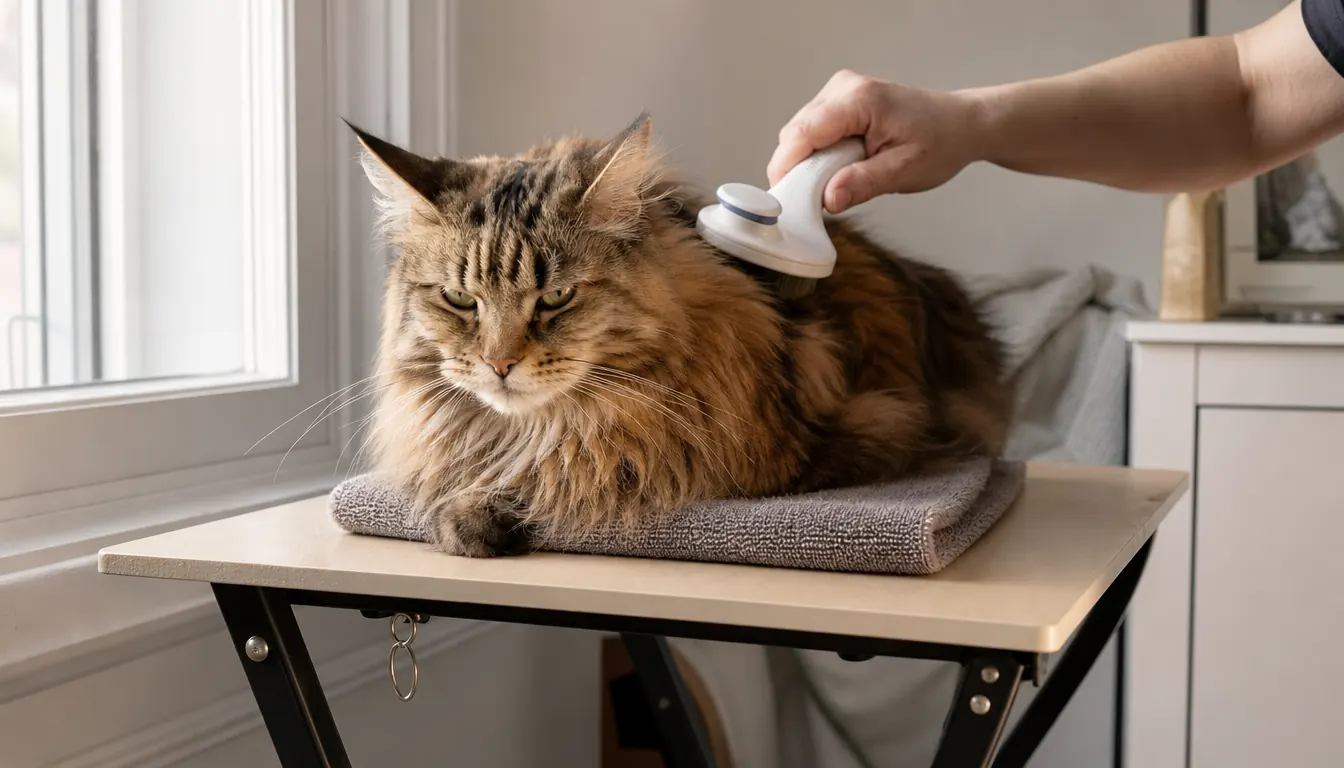
Juniper sheds like it is her job. She is seven, a long-haired Maine Coon mix, about fourteen pounds, and every spring she leaves a gray film on the back of the couch that I can write my name in. Pip is four, short-haired, nine pounds, and somehow contributes his own share of orange lint to every dark sweater I own. For years I fought all of it with lint rollers, a vacuum attachment, and a rotating cast of brushes that ended up in the same drawer, unused.
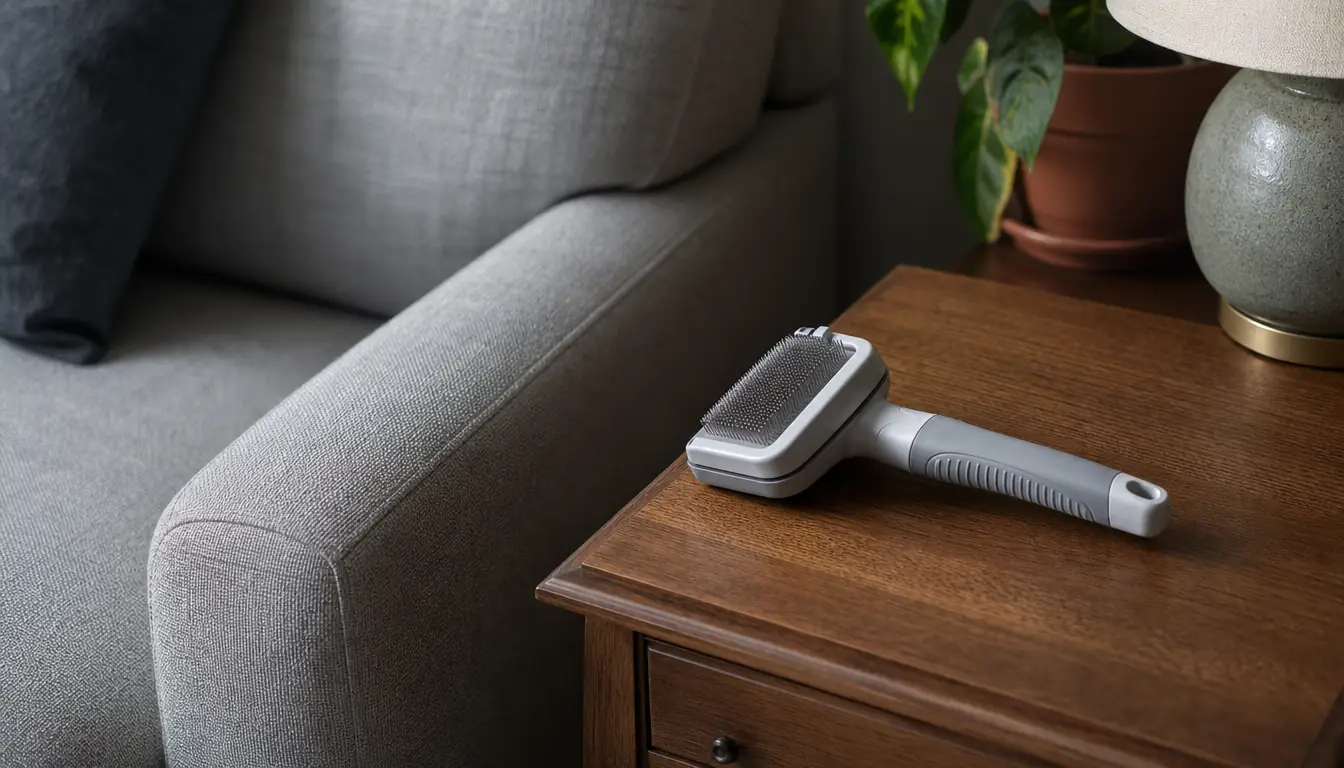
About eight months ago I swapped the whole pile for one tool: the Aumuca cat brush for shedding. It is a slicker-style brush with stainless steel pins bent at a 150-degree angle, round rubber tips on the ends, and a one-click button on the handle that pushes the pins back so the collected hair slides off the pad instead of into my fingernails. I brush Juniper most evenings for a few minutes and Pip lightly once a week. Here is what actually changed in this house.
One press of the button and the pad is empty. Two cats is enough work without picking fur out of bristles.
Light enough for a four-minute pass on a long coat, with round rubber tips so a cat who tolerates brushing keeps tolerating it.
Amazon Check Today's Price on Amazon →It lifts a week of loose fur off a long coat in about four minutes
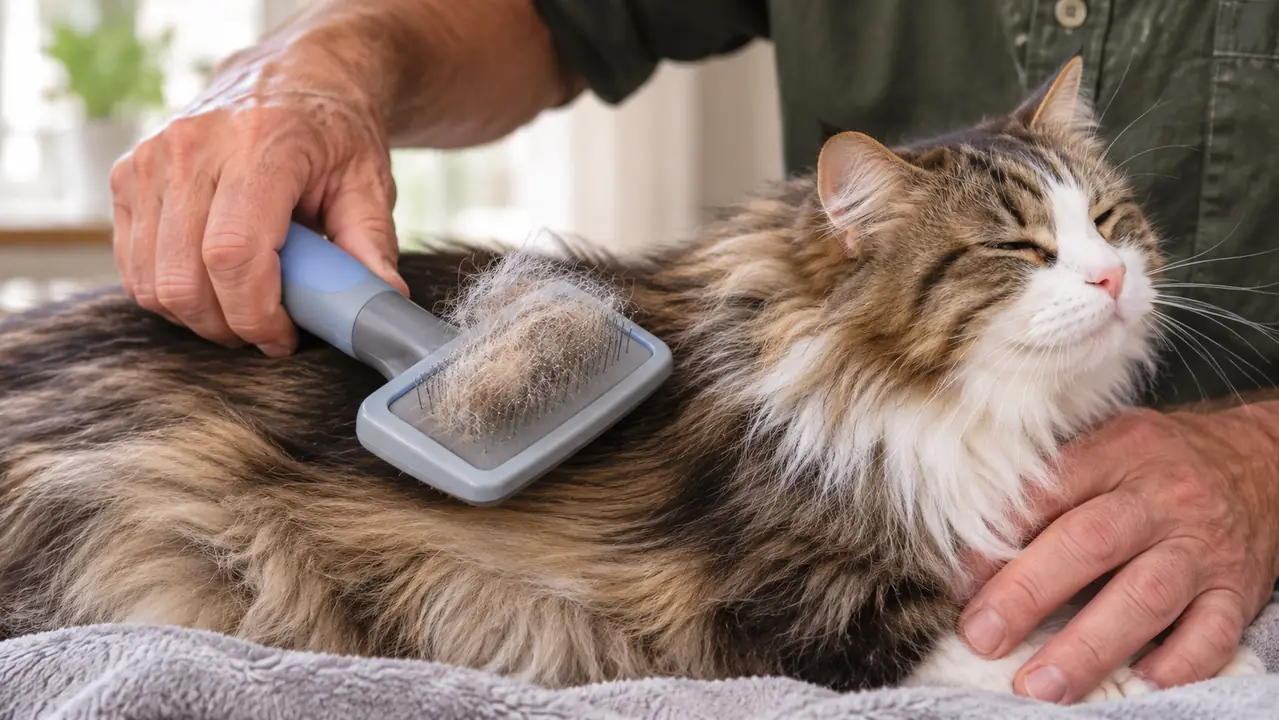
Juniper tolerates grooming in short doses, so speed matters more than thoroughness. I start at her shoulders, work down her back in overlapping strokes, then do the sides and hindquarters where the coat is thickest. Four minutes, maybe five on a heavy shed day, and the pad is full. Before this I would brush for ten minutes with a pin brush and still find loose tufts the next morning. This gets the undercoat that was already loose and about to land on the furniture anyway.
The one-click button means I never dig hair out of the pins
Every brush I owned before this had the same ending. I would sit there peeling a felted mat of fur off the bristles with my fingers, which took longer than the brushing did. Here you press the button on the handle and the pins retract, so the hair slides off the pad in one piece. I do it over the kitchen bin. Two seconds, then back to the cat. That one detail is why this brush is still in the drawer and the others are not.
The 150-degree bent pins get under the topcoat instead of skating over it
A flat slicker skims the surface of a long coat. The pins here are bent at a 150-degree angle, so as you draw the brush back they catch the loose fur sitting closer to the skin rather than just fluffing what is on top. On Juniper's back legs, where the coat is dense and the shed is worst, the difference is obvious. I get a fuller pad and fewer tufts on the floor afterward. It also means fewer passes, which is the whole ballgame with a cat who has a time limit.
Round rubber tips let a cat who does not love brushing stay put
The pins are stainless steel, but each one has a round rubber tip on the end. Juniper is not a cat who loves being groomed. She will sit for a few minutes if the pressure is light and nothing is scratching her skin. With a plain wire slicker she flinches and leaves. With this one she stays for the full pass and walks off on her own terms, which is the best outcome I have gotten from her. Pip, who has no patience at all, gets a light weekly pass and puts up with it.
It stops the mats behind Juniper's ears from getting started
A brush will not dissolve a mat that has already tightened, and I am not going to pretend the Aumuca does. What I do is work the mat loose with my fingers first, a little at a time over a couple of days, then brush the area once it has some give. What the brush has done is keep the rest of the coat from tangling into new mats, so I am maintaining one small spot instead of chasing them all over her body. That is a real cut in how often I have to do the tedious part.
It works on a short-haired cat at a much lighter touch
Pip is four, nine pounds, orange tabby, and he sheds less than Juniper but still leaves a haze on the arm of the chair he has claimed. Short coats do not need the same pressure. I use the brush lightly, one pass with the lie of the fur and one against, once a week. He tolerates it because it is over fast. The pad comes up with a surprising amount of fine undercoat for a cat who looks sleek. Same tool, different job, which is why I stopped buying a separate brush for each cat.
At 5.6 ounces, my wrist gives out after the cat does, not before
Long grooming sessions are a wrist workout, especially when you are holding a cat steady with the other hand. This brush weighs 5.6 ounces. That is light enough that I can do Juniper's full routine, then a quick pass on Pip, then wipe the pad, without my forearm aching. The handle is plastic and shaped so my grip does not slide when my hands are dry from the winter. Small thing. It is also the reason I use the brush most evenings instead of skipping it.
It fits in the craft table drawer, which is where I actually keep it
My grooming spot is a folding craft table in the spare room with a towel on it, next to the window. The brush is small enough to live in the top drawer with the nail clippers and the wipes, so it comes out in one motion and goes back the same way. Anything that needs to be displayed on a counter is something I stop using. This does not need a home on the counter, and the drawer is the reason the habit stuck past the first month.
More hair ends up on the pad and less of it ends up in the air
I am not going to tell you a brush stops a cat from shedding. It does not. Juniper still sheds, and there is still hair on the couch, just less of it and less often. What changed is where the loose fur goes. Most of it now comes off on the pad and into the bin instead of drifting onto the furniture or into the corner where I find it weeks later. In a two-cat house, that drop in ambient fluff is the thing I notice most.
A calmer brushing session makes the nail trims go better
Both cats get their nails done every two to three weeks with a small pair of stainless clippers with a concave blade. Nobody enjoys it. Pip does two or three nails, takes a treat, and finishes later the same evening. What I noticed after a few months of regular brushing is that the nail sessions start from a calmer place, because grooming in general stopped being a fight. The brush did not fix nail trims. It made the whole routine less of an event, and that carries over.
What I'd Skip
If I were starting over with two shedding cats and no drawer full of rejects, I would skip three things. Lint rollers, because I was buying them in multi-packs and going through one a week. Rubber curry combs, which Pip liked and which did almost nothing for Juniper's undercoat. And any brush whose pins do not retract, because the cleaning is what makes people quit. I would also skip brushing a matted area cold. Work the mat loose with your fingers first, then brush. Pulling a tight mat with any brush hurts, and a cat remembers.
Four minutes down the back and sides, one press of the button, and the pad goes into the bin empty. That is the whole routine now.
The brush that made me stop buying lint rollers in multi-packs
The Aumuca has been in the top drawer of the craft table for eight months. One click empties it, and neither cat has to sit through the fingernail routine again.
Amazon Check Today's Price on Amazon →