

Pip is nine pounds of orange opinion, and for the first two years I had him, nail day ended with me bleeding and him under the bed. I did everything the internet told me to do. I wrapped him in a towel. I tried the scruff hold. I tried one nail a day for a week, which mostly taught him to bolt the second I sat down on the floor. My older cat Juniper would sit through a trim like she was being paid for it, and honestly that made it worse, because it was easy to decide the problem was Pip.
The problem was not Pip. It was a tool sized for a dog and a plan sized for a patient animal. Six months ago I switched to the Pet Republique cat nail clippers and rebuilt the whole routine around what a cat will actually tolerate. They are small, about four and a half inches, stainless steel, with a concave blade and a grip that is bigger and softer than the drugstore pair I started with. Juniper still does not care either way. Pip still objects. The difference is that I now get all eighteen nails done in a single evening and neither of us ends up hiding.
The pair I reach for on both cats, including the one who fights
Small stainless steel clippers with a concave blade, sized for cats and kittens rather than dogs, with a soft grip that stays put when the paw pulls away. Six months of use on two very different cats and it is still the only pair in my drawer. Today's price on Amazon.
Amazon Check Today's Price on Amazon →Step 1: Set the room before the cat knows anything
Cats read a room faster than we give them credit for. If I walk into the spare room with a mission and start unfolding furniture, Pip is gone before the towel is out. So setup happens ten minutes early, quietly, while both cats are asleep. I keep a folding craft table in the spare room by the window, and I put a bath towel on it. The towel is not for the nails. It stops the paws from sliding and gives the cat something to grip that is not my forearm.
I also close the door. Not to trap anybody, but because a cat who can leave will leave, and then the whole thing turns into a chase through the house. A closed door is a decision I make once, and then I have to be quick about it. With two cats on a two to three week schedule, quick beats thorough every time. Two calm minutes behind a closed door is worth more than an hour of stalking an open house.
The last piece is where I sit. A chair, table at chest height, cat on my lap facing away from me. A cat facing away cannot see the clippers coming and cannot brace against them. That single detail did more for Pip than any treat I tried. The table sits just under my collarbone when I am seated, which means my elbows stay low and my hands stay level instead of reaching down. If you are working on the floor instead, put the cat between your knees with his back against your stomach and keep your voice low and boring. Boring is the goal.
Step 2: Do the easy cat first, while the room is still calm
Juniper goes first. She is seven, a long-haired Maine Coon mix, and she treats a nail trim the way she treats being brushed, which is to say she tolerates it while it stays short. Doing her first is not really about her. It settles me. My hands stop being nervous, I remember how the blade feels against a nail, and by the time I pick up Pip I am not guessing.
On Juniper I do the front paws first, then the back. Front nails are larger and they curl less, so they are the easiest place to start on any cat. The back nails I take only the points. She wears hers down on the scratching post by the sofa, so most months there is not much to remove, and taking more than the tip on a back paw buys me nothing but risk.
One thing I did not expect at seven: the nails get thicker. Juniper's have grown a rougher, layered edge in the last year, and a thin slice off the tip keeps them from snagging on the bedspread. If a nail looks split or flaky, I take less, not more. A split nail cut too close is how you end up at the vet on a Saturday morning. Her front nails had also started to curve inward toward the pad this spring, which is why the two to three week schedule is not optional for her, and why the first trim after a gap is always the smallest.
Step 3: Hold the paw like you are holding a hand
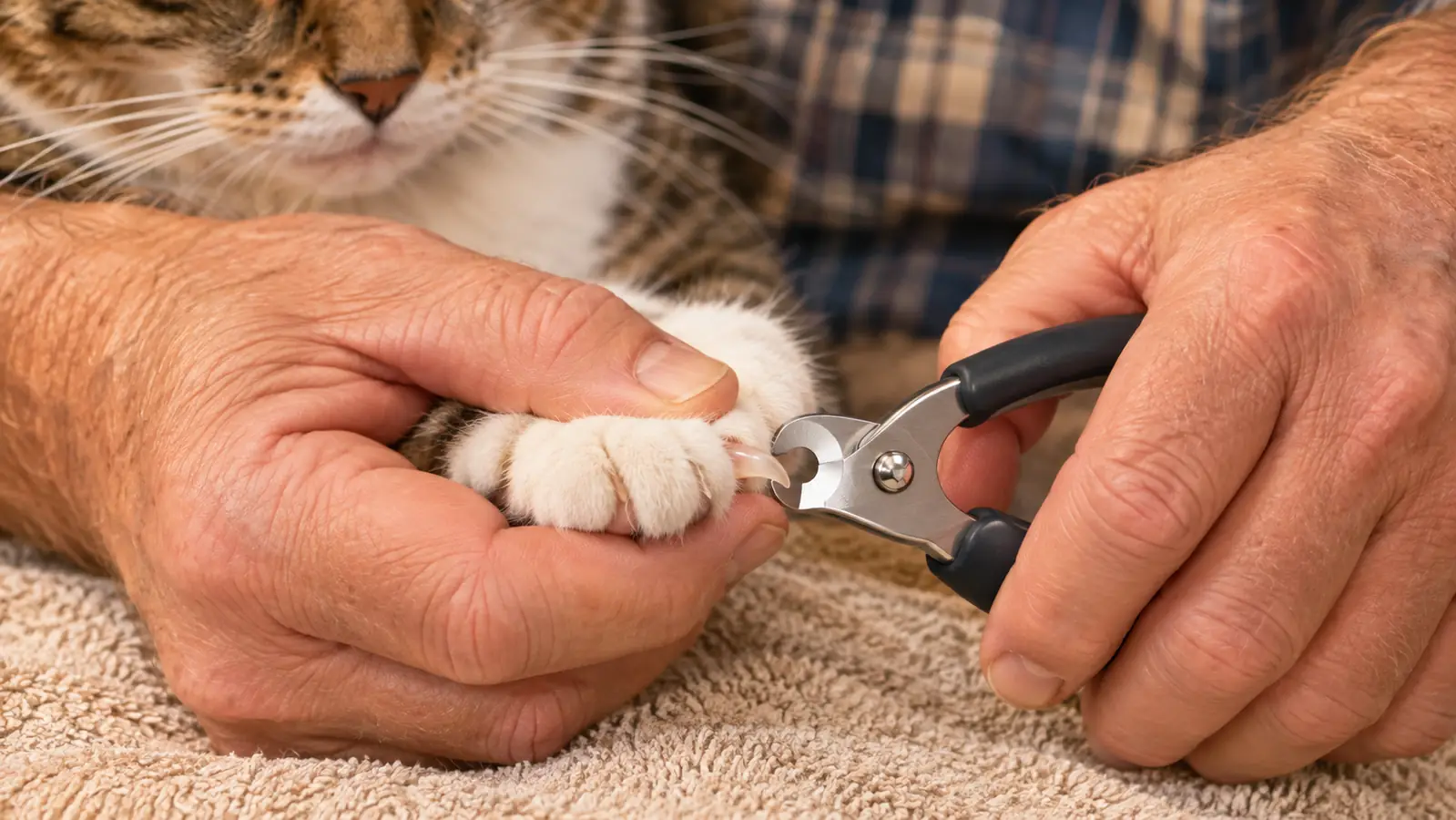
You do not squeeze a paw. You wrap your hand around the top of the foot, rest your thumb on the pad, and press gently until the nails come out. That is the whole grip. If the cat pulls, let the paw go, wait a beat, and take it again. You are borrowing the paw, not confiscating it, and cats can tell the difference.
The clipper sits so the concave curve wraps the curve of the nail. That is the reason I stopped using a straight human-style clipper. A straight cut across a curved nail crushes the edges, and a crushed nail frays and catches on fabric for a week. Line the blade up, one clean squeeze, and you are done. If it takes two bites, the blade is not sitting where it should be.
The cut itself happens at the tip. On a light nail you can see the quick as a pink core and stop a couple of millimetres short of it. On a dark nail you cannot see anything, which is where a drop of baby oil helps. I put a little on a cotton swab and touch it to the nail, and the quick shows up darker against the shine. The first time I tried this I used too much and had to wipe oil off the towel for five minutes, so a thin film is plenty. I have not cut a quick in six months with the Pet Republique pair. The only time I did was years ago, with a dull clipper, on a nail I was rushing.
Step 4: Two nails, one treat, then start over
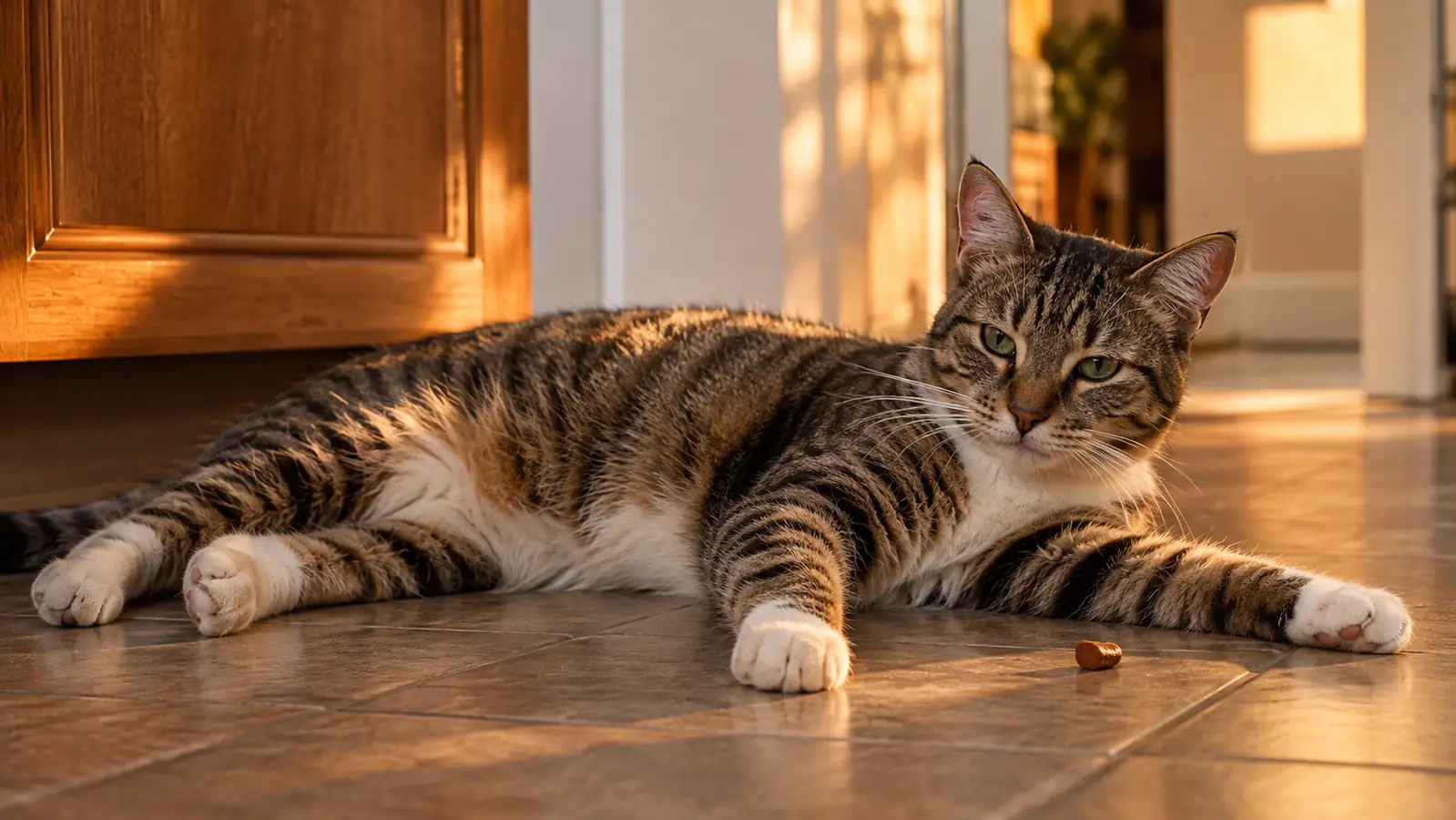
Pip gets two or three nails and then he is finished. Not because some guide says three, but because I have learned exactly where his patience ends and it ends around nail three. I put him down, give him a treat, and let him walk out of the room. Ten minutes later I pick him up again for the next two. The second round is almost always easier than the first, because he has learned that the session ends when he says it does.
This is the part that took me the longest to accept. A trim does not have to be one event. Tonight it might be three rounds, and that is still one evening, still one set of nails, still done. Some nights it is two rounds. There have been two evenings in six months where I did a single nail and quit, and both of those were my fault for starting when the house was loud. The clippers are small enough that I can hold them and the paw in one hand, which matters when the other hand is doing the work. I keep the treat jar on the windowsill, not in a drawer, because a drawer makes noise and noise is what resets him.
The treat matters more than people think, and it has to come immediately, not after the last nail. If the reward shows up at the end, the cat learns that the scary part is long. If it shows up after every second nail, the cat learns that the scary part is short. Same number of treats, completely different lesson. I use about twelve tiny pieces across a full Pip trim, which sounds like a lot until you count the nails.
Step 5: End on something good and check again in a week
The last thing that happens in my house is not the last nail. It is the release and the treat, in that order, before I put anything away. Then the clippers go back in the top drawer of the craft table and I leave the room. The point is that the cat's last memory of that table is being let go, not being held.
A week later I run a thumb over each paw while the cat is half asleep on the sofa. If a nail catches on the towel or on my sleeve, it gets a touch up. This is a thirty second check and it catches the one nail I missed, which is almost always the same one, the outer nail on Pip's left back paw that he keeps tucked. Juniper does not have a missed-nail problem, she has a back-paw problem, and the check is how I notice hers before she starts catching on the rug.
The schedule here is every two to three weeks for both cats. That is more often than most people trim, and it is deliberate. Small amounts removed often is easier on everyone than a big correction every two months. It also means that if a session goes badly, I can stop without guilt, because the next one is only a fortnight away.
What Else Helps
A second pair of hands is not required, and I would argue it is a hindrance. Every time my husband held a cat for me, the cat fought harder, because two people means something serious is happening. One calm person and a closed door works better. What does help is a scratching post the cat actually uses, since wear is free nail maintenance, and a towel on the table instead of a bare surface. If you are trimming a cat who is older or arthritic, put a folded towel under the paw you are holding, so the joint is supported rather than dangling.
For a cat who will not sit still for a brush or a held paw, a pair of grooming gloves is worth mentioning. They are for petting, not trimming, but a cat who will not be held will often stand for a hand run down his back and over his feet, and that slowly teaches him that having his paws touched is ordinary. The other thing that helps is a vet check once a year. If a nail is curling into the pad or a paw smells wrong, that is not a trimming problem, that is a vet problem. A clipper is a tool, not a cure, and no pair of Pet Republique clippers will fix a nail that has already grown into the toe.
I have never once calmed Pip down. I have only gotten faster than his objection, and faster is something you can practice.
Eighteen nails, one evening, no towel burrito
Small stainless steel clippers with a concave blade, sized for cats and kittens, with a soft grip that holds steady when the paw pulls back. Six months in and it is still the only pair in my drawer. Today's price on Amazon.
Amazon Check Today's Price on Amazon →