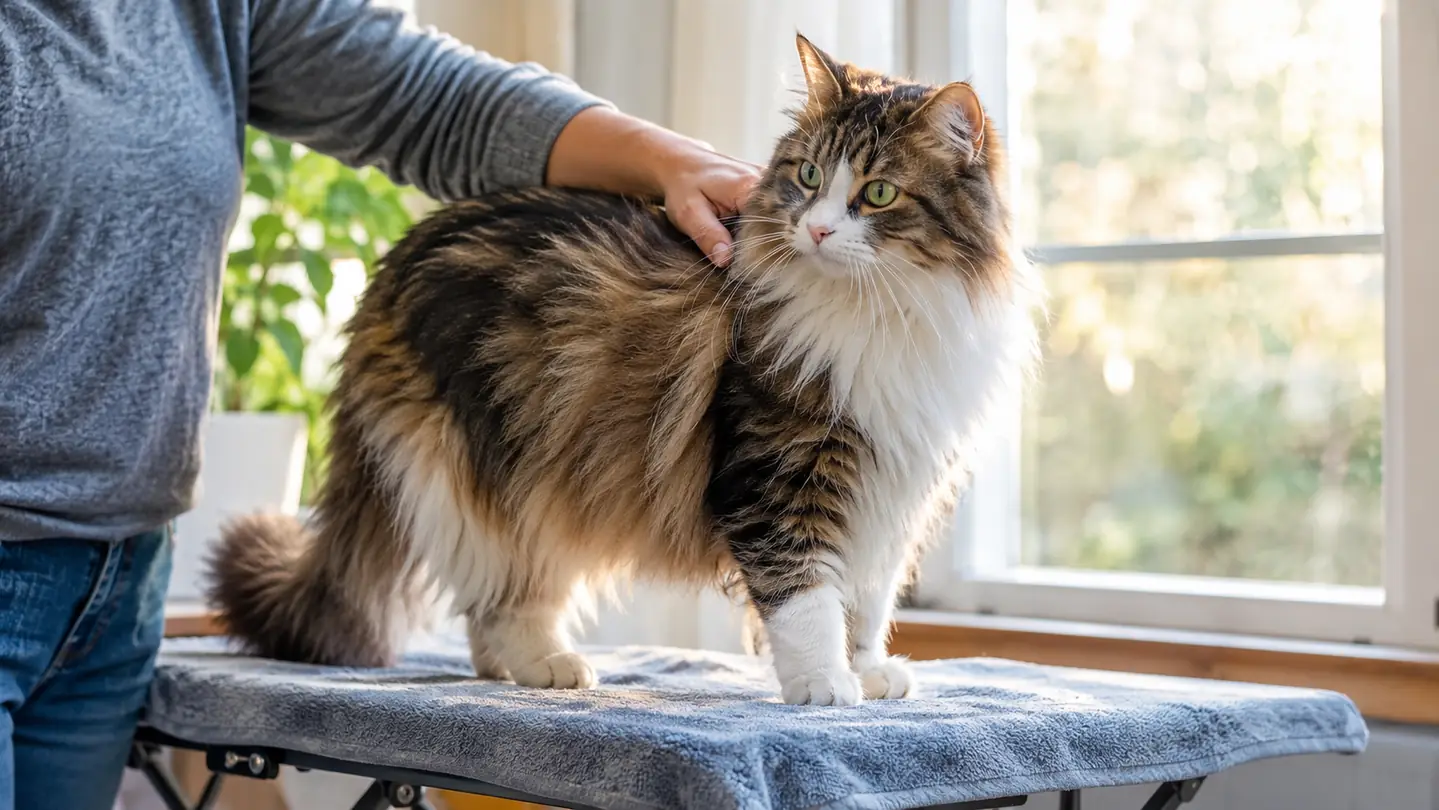
A cat bath is a two-person job, a wet bathroom floor, and a cat that will not look at you for the rest of the evening. I have done it. I do not recommend it for routine dander. What works better in my house is a wipe-down: a warm room, a towel on the folding table, and a pack of pet wipes I keep in the top drawer. For the last three months, the pack I reach for is Burt's Bees for Pets Cat Wipes, the unscented dander-reducing kind, 50 count. It has replaced most of the baths I used to talk myself into.
A wipe is not a bath. It does not soak the coat, it does not rinse anything out, and it will not fix a cat that has walked through something sticky. What it does is lift the loose surface stuff, the saliva and skin cells that collect on the coat, and the dander that comes with them. If your goal is a cat that leaves less on the sofa and a sister with a mild allergy who can sit down without reaching for a tissue, this is the routine I would start with.
The wipe that made our bath nights rare
Burt's Bees for Pets Cat Wipes are 6.8 by 7 inches, unscented, and made without fragrances, sulfates, colorants, or harsh chemicals. I use them a few times a week on hindquarters and paws, and on both coats before my sister visits. The pack is 50 count, which lasts me about three to four weeks.
Amazon Check Today's Price on Amazon →Step 1: Set the room before you bring the cat in
The mistake I made for years was starting with the cat. Start with the room. I use the spare room, the folding craft table, and a towel I do not mind washing. The table sits near a window, which gives me light without an overhead lamp buzzing. I close the door. I put the pack of wipes, a couple of paper towels, and a brush within reach on the right side, because I am right-handed and I do not want to reach across the cat. The first version of this routine happened on the bathroom counter, with the door open and the hallway light on, and it failed twice in the same week. The counter is cold, the mirror gives the cat a second cat to watch, and an open door is an invitation to leave. A towel on a table fixed all three problems, and it cost me nothing but the walk down the hall.
Then I wait. A cat that is already wound up from being chased will not settle for a wipe. I open the drawer, take out the pack, and set it on the towel. I let the cat come to the table. Juniper, my long-haired Maine Coon mix, usually hops up on her own if I tap the towel twice. Pip, my orange tabby, needs a minute. If either one walks away, I let them. There is no prize for forcing it. The sessions that go badly are almost always the ones I started because it was convenient for me and not because the cat had settled.
The temperature matters more than people think. A cold wipe on a cold evening gets a flinch, and a flinch turns into a cancel. I keep the pack in the house, not the garage, and I run the wipe between my fingers for a second before it touches the cat. That is not a product feature, it is just less of a shock. In January I made the mistake of leaving the pack by the back door overnight, and the first touch of that wipe got me a tail flick and a closed session.
Step 2: Read the cat, then follow the direction on the pack
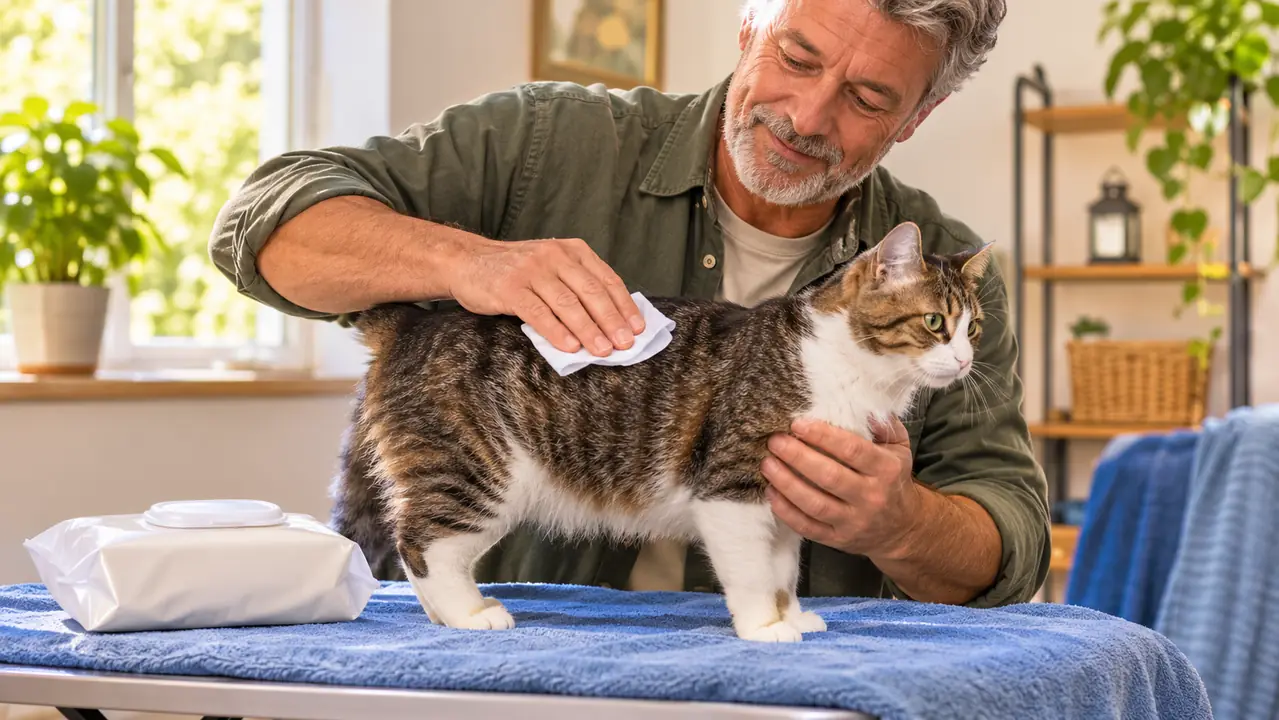
The directions on Burt's Bees for Pets Cat Wipes say to wipe from the back of the ears to the tail, avoiding the eyes. That is the whole map, and it is a better map than the one I used for the first year. I start at the back of the ears, not the face. The face is where a cat keeps its boundaries, and a wipe near the eyes is how you turn a calm cat into a pretzel. The first time I tried this, I began at the chin because that seemed like the polite place to start. I got about four seconds before Pip was off the table and under the bed, and I spent the next ten minutes pretending I had not just done that.
I do the back of the ears, then the neck and shoulders, then down the spine in long, light strokes. I am not scrubbing. The wipe is damp, not dripping, and it picks up a surprising amount of fluff from Juniper's coat. On Pip, the short-haired one, I use less pressure and go over the same area once. Twice on a short coat just makes the wipe dry and the cat twitchy. I also keep my free hand flat on the cat's shoulder rather than around the middle, because a hand on the shoulder steadies while a hand around the ribs reads as a hold.
If the cat turns around to sniff the wipe, I stop and let them. I do not scruff, and I do not pin. The point is to make this boring. A boring thing gets repeated. A dramatic thing gets remembered and avoided, and a cat that remembers will be on top of the refrigerator before you get the drawer open. My rule is simple: one tail flick, I keep going. Two, I stop for the night and try again tomorrow.
Step 3: Do the coat in sections, and change the wipe when it loads up
A full-body wipe with one wipe is a mistake. The wipe picks up oil and loose hair, and after the first side it is just moving the same stuff around. I use one wipe for the back and sides, then a fresh one for the hindquarters and the back legs. The pack is 50 count, and a pack lasts me about three to four weeks at a few sessions a week. That math is the reason I do not feel bad about using two wipes on a long-haired cat. Two wipes per session, roughly four sessions a week, and I am still opening a new pack once a month rather than once a week.
The hindquarters are where the dander and the loose stuff collect on Juniper. I lift the tail base just enough to get the wipe flat, and I go with the grain, away from the body. I do not dig into the tail. The back legs get a pass down to the hocks, where the fur goes thin and the skin is easy to irritate. The paws get a quick wipe on the top and between the toes, but only if the cat is still settled. If the cat is done, the paws can wait for another night. There is always another night.
I save the chest and the under-chin for last, and I use a corner of the wipe, not the whole thing. That is close to the face, so I go slow and I keep my hand low, below the cat's eye line. The wipe is 6.8 by 7 inches, which is big enough to fold into a smaller pad. A folded edge is easier to control near the chin than a full sheet, and it keeps me from accidentally swiping across a whisker pad. Juniper will allow the chin. Pip will allow about two seconds of it, and then we are finished.
Step 4: Handle mats and sticky spots separately, not with more wiping
A wipe will not break up a mat. I learned that the expensive way on Juniper's back legs. If I find a tight mat behind her ears or on her britches, I do not scrub it with a wipe. I work it loose with my fingers first, a little at a time, and then I brush the area after. The wipe goes on the coat around the mat, not on the knot itself. Wiping a mat just wets the top of it and makes the knot tighter and harder to read.
The same goes for a sticky spot. If a cat has something on the coat that is tacky, a wipe will smear it. I blot with a damp paper towel first, let it sit for a second, and then use the wipe to go over the area. If it is still tacky after that, it is a bath problem, not a wipe problem. I would rather do one real bath when it is needed than ten wipes that do not finish the job. One bath in a season is an event. Ten half-finished wipe-downs that never quite work are a routine nobody in the house enjoys.
This is also where I stop if the skin looks angry. A wipe is for the coat. If I see redness, scabs, or a bald patch, I do not keep wiping and hope. I call the vet. The pack says it is formulated with ingredients from nature, including colloidal oat flour and honey, but that is not a diagnosis. It is a wipe. There is a difference, and I would rather look silly asking a question than keep going on a sore spot.
Step 5: Let the coat dry, then brush, and reset the room
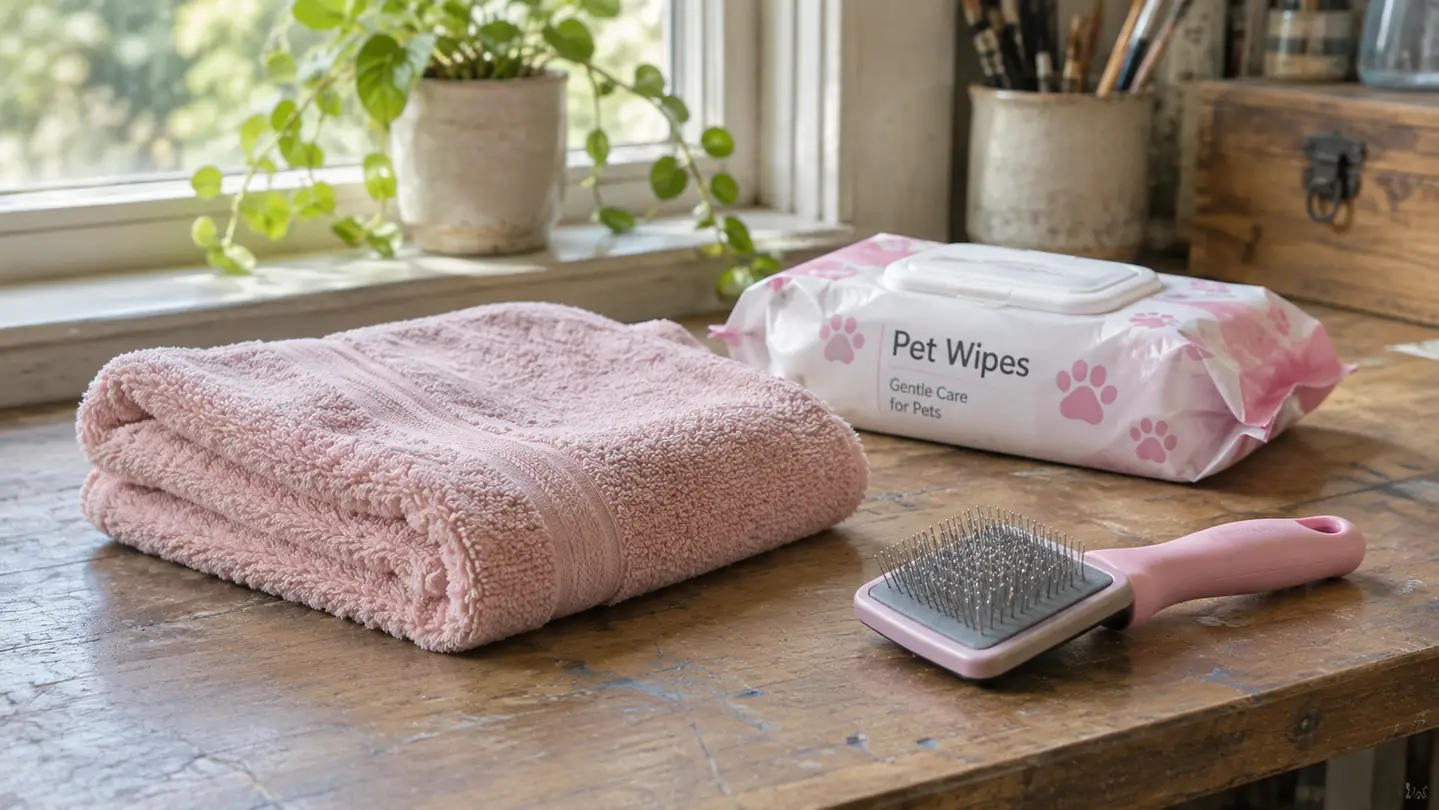
A cat that is wiped and then immediately brushed is a cat with a wet brush. I give it five or ten minutes. The coat does not need to be bone dry, but it should not be damp to the touch. I use that time to wash my hands and fold the towel. Then I brush. The brush is what gets the loose hair that the wipe loosened. The wipe is not a substitute for the brush, and the brush is not a substitute for the wipe. They do different jobs, and skipping one of them is why some people wipe for a month and decide it did nothing.
I brush Juniper's back and sides with the slicker, and I go light on the hindquarters where the coat is thinnest. On Pip, I use the grooming glove for a minute because he will sit for a hand and not for a brush. Last Tuesday I did the wipe-down at about seven in the evening, let both cats go, and brushed Juniper at eight on the towel while the light was still coming through the window. The hair that came off her in that five minutes was hair the wipe had already lifted. That is the order that works.
Then I put everything back in the top drawer. The pack gets closed properly. A wipe that dries out is a wipe I throw away, and at 50 to a pack I do not want to waste them. I also wipe the table down and shake the towel outside, because dander is light and it settles. If I skip that part, I have just moved the dander from the cat to the table and back onto the cat the next time.
The wipe does the surface work, the brush gets the loose hair, and the bath stays in the cupboard for the days that actually need it.
What Else Helps
The wipes are the center of this routine, but they are not the whole routine. The biggest drop in dander in my house came from brushing Juniper most evenings for a few minutes and vacuuming the two rooms she spends the most time in. A wipe-down cat on a dirty rug is still a dander problem. I wash the towel after every two sessions, and I wash the cat beds every other week, which is more often than I used to and less often than the allergy forums suggest.
I also keep the pack where I can see it. The top drawer of the craft table is fine for storage, but if the wipes are buried under the nail clippers, I skip the wipe-down. A pack on the table is a reminder. That sounds small. It is the difference between a routine and a good intention, and I have the abandoned routines in the closet to prove it.
If you are deciding between this pack and a water-based pet wipe, there is a comparison worth reading before you restock. There is also a longer look at how the pack holds up over months. The short version: the Burt's Bees pack is the one I restock. It is unscented, it is made without fragrances, sulfates, colorants, or harsh chemicals, and it does not leave Juniper's coat tacky. That last part is why I keep using it. A wipe that leaves residue is a wipe I will not finish, and a pack I will not finish is a pack I stop buying.
Three minutes now beats a bath on Sunday night
Burt's Bees for Pets Cat Wipes are 50 count, unscented, and sized at 6.8 by 7 inches. If your cat will stand for a towel and a light hand, this is the routine I would try first. Start at the back of the ears and work toward the tail.
Amazon Check Today's Price on Amazon →