Pip will lie across my lap for twenty minutes, purring, while I scratch behind his ears. Then I reach for a brush and he suddenly remembers he has somewhere else to be. For about a year that was the whole problem in this house: one short-haired cat who needs almost nothing and refuses even that, one long-haired cat who tolerates brushing for roughly ninety seconds, and a pair of bare hands that mostly just moved loose hair from the cat onto my sweater.
So I tried the HandsOn grooming gloves. They are what they sound like, a pair of gloves with rubber nodules across the surface, machine washable, and the idea is that your hand becomes the brush. Pip does not see a tool. He sees a hand that is petting him, and petting is the one grooming-adjacent activity he has never once objected to. Five weeks in, this is the first thing I reach for and the only thing he will sit still for. Here is exactly how I use them, step by step, including the parts that went sideways.
The grooming tool your cat will mistake for petting
HandsOn grooming gloves, one pair, machine washable. Pip went from ninety seconds of tolerance to a full session. If your cat treats a brush like a betrayal, start here.
Amazon Check Today's Price on Amazon →Step 1: Set the room up before the cat is in it
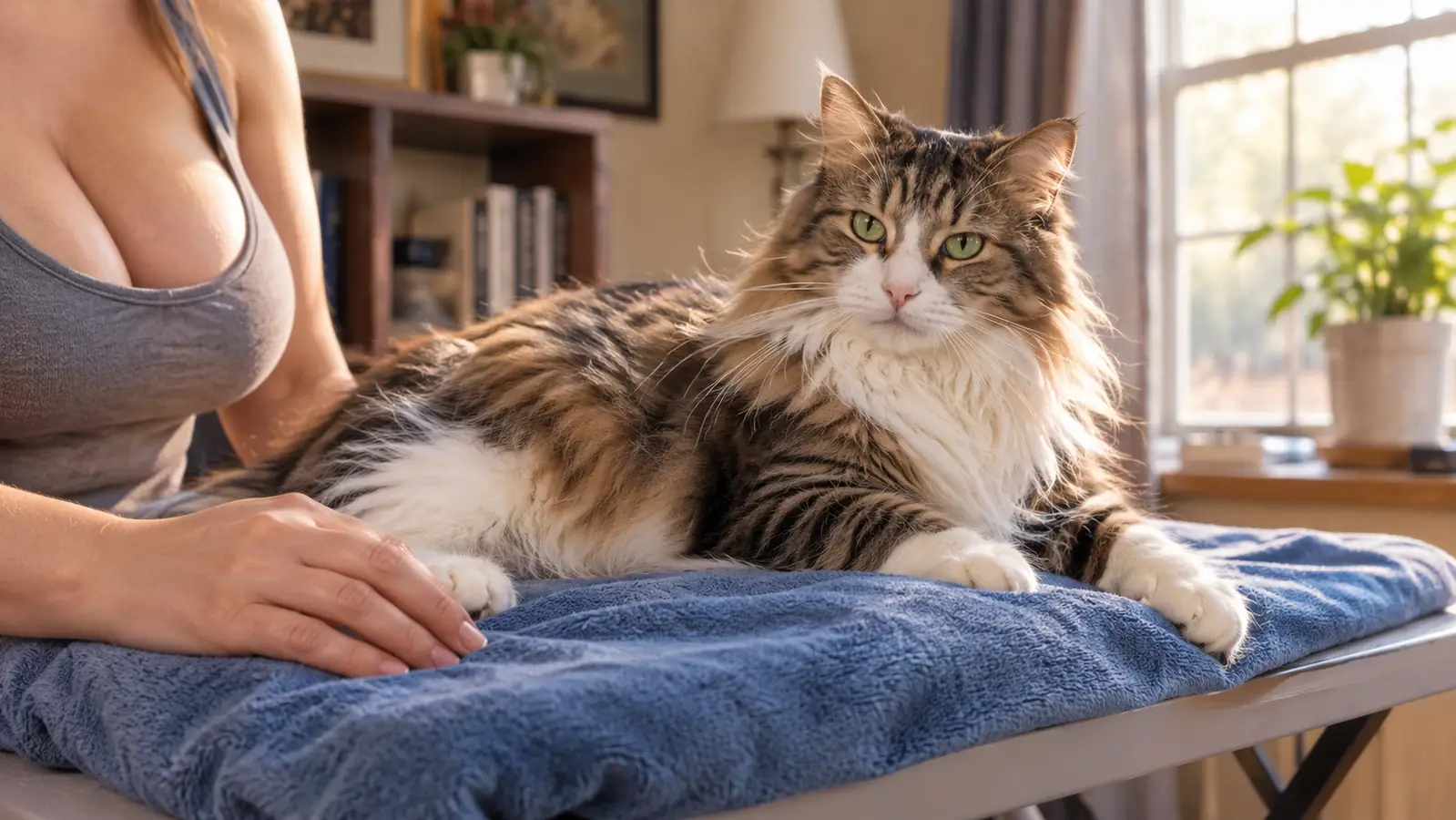
I groom on a folding craft table in the spare room, with a towel folded over it and one corner of the table angled toward the window. The window matters more than it should. Juniper settles when she has something to look at, and a cat watching a bird is a cat not watching your hands. The table is about two feet deep, which sounds small until you realize a cat will only use the front half of it anyway.
Before I bring either cat in, I close the door, put a treat on the towel, and set the HandsOn gloves within reach. Everything I need is already on the table, because the moment I stand up to fetch something, the session is over. Cats do not grant extensions.
Timing is the other half of this step. Pip gets groomed in the evening, after he has eaten and after he has already gone soft and sleepy on the couch. Mid-afternoon, when he is running laps through the hallway, I do not bother. A session on a wired cat lasts about four seconds and teaches both of you the wrong lesson.
Before the craft table, I groomed on the bathroom floor, which was a mistake for two reasons. Tile is cold, so Pip spent the whole time trying to get his feet onto something warmer, and there was nowhere to put the gloves down except the bathmat. I also tried the living room couch for about a week. That lasted until Juniper decided the towel was hers and it ended up dragged under the coffee table. The spare room works because the door closes and nothing in there is more interesting than the person holding the treats.
Step 2: Check for mats with your bare hands first
A glove is a deshedding tool. It is not a mat splitter, and no amount of scrubbing will turn it into one. So before I put anything on my hands, I run my fingertips over Juniper in the spots where mats actually form: behind her ears, the backs of her hind legs, under her front legs where the coat rubs, and along the belly line.
If I find one, I work at it with my fingers first, teasing the hairs apart a few at a time from the outside edge inward, and I brush that area afterward. If it is tight against the skin, hard and dry and not moving at all, I leave it alone and let a groomer handle it. Pulling on a tight mat with a glove is just pulling on skin, and a cat who gets hurt once will remember it for months.
Pip has a short coat and no mats, so for him this step is quick. It still takes longer than it should, because he reads any hand on his hindquarters as an invitation to roll over, so I fold the check into a normal petting pass instead of a separate examination and keep the whole thing under a minute. What I am feeling for is heat, a scab, or a patch where the fur suddenly gives way under my fingers. In the years I have been doing this I have found one hot spot and one tick, and both were worth the trouble of checking.
Step 3: Let the cat meet the glove before it grooms anything
I put the gloves on, sit on the floor, and do nothing useful. That is the step people skip. Pip gets to sniff the nodules, back away, come back, sniff again. I feed him two treats while wearing them so the smell of the gloves lands in the same part of his brain as the smell of treats. Then I pet him exactly the way I always pet him, no grooming strokes, no reaching for the coat.
The first session, that is all we do. Four minutes, two treats, done. The second session I add one stroke down his back, then back to normal petting. It took four sessions before Pip would tolerate a full pass, and about two weeks before he stopped flinching when he saw my hands coming toward him.
Juniper is a different story. She is fine with a brush on her back and sides, so the gloves are not for that. Where I use them on her is her face and chest, where the slicker brush makes her ears go flat and her tail start ticking. A gloved hand on her chest is just a hand on her chest. She leans into it.
The evening it clicked with Pip, I remember the sequence because I wrote it on the back of a grocery receipt afterward. Gloves on, sat on the floor, no treats in my hand yet. He walked over, sniffed the right glove, and bumped his cheek into my knuckles. I petted him normally for about two minutes, then did three strokes down his back and stopped. He stayed. I gave him a treat and took the gloves off while he was still sitting there. That was somewhere around the eleventh session, if I am counting, and it was the first one that did not end with him leaving the room.
Four sessions before Pip tolerated a full pass. Five weeks in, he walks onto the towel himself when he hears the gloves come out of the drawer.
Step 4: Work in short strokes, in the direction the coat grows
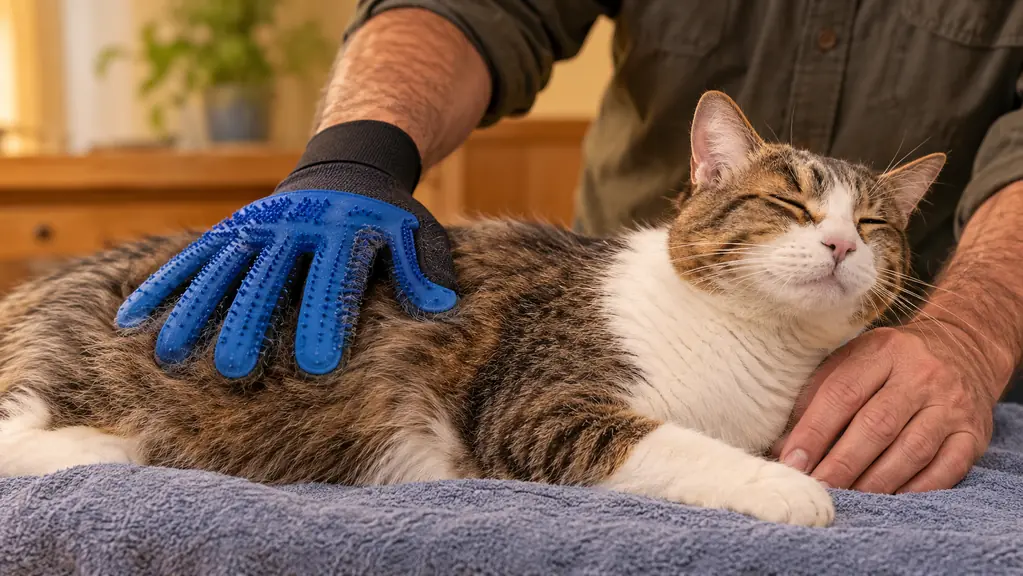
Short strokes, maybe four inches at a time, going the way the coat lies, from the shoulders toward the tail. Light pressure. The nodules do the work, and pressing harder does not pull more hair, it just tells the cat that this is something to be endured rather than enjoyed.
On Pip I do his back, his sides, and the top of his hindquarters, which is where the loose hair collects into little drifts that come off in one pass. On Juniper the gloves get her chest, her cheeks, and the front of her neck, then I switch to the slicker brush for her back and hindquarters where the coat is thickest. One tool, one job. The gloves do not replace a brush on a long coat. They cover the parts a brush cannot reach without a fight.
A full pass on Pip runs about forty strokes, and I count them in my head so I do not overshoot. The first time I did a proper session I got greedy. There was a sheet of hair coming off him and I kept going, back and forth, until he stood up and walked off mid-stroke. That cost me three days of trust, which I spent re-earning with treats and normal petting. Now the sheet of hair is not the goal. A short session with a cat who comes back tomorrow beats a thorough one with a cat who hides under the bed.
Three to five minutes is a whole session. When Pip's tail starts a slow tick and his ears rotate back a quarter inch, I stop, even when there is clearly more hair to come. Stopping while the cat is still happy is what makes the next session possible. That single rule did more for my grooming routine than any tool I have bought.
Step 5: Peel the hair off the nodules and reset
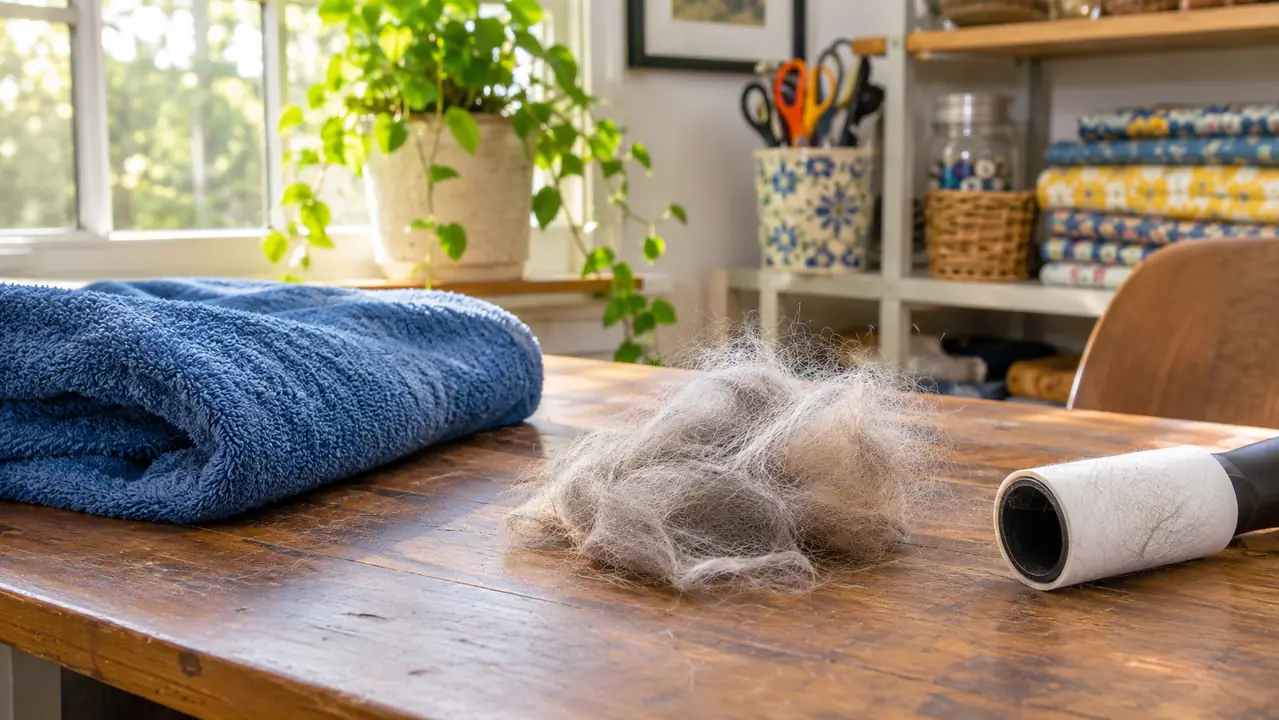
The hair gathers on the nodules in a flat sheet, like felt. When it gets thick enough that the glove stops grabbing, I peel it off in one piece and drop it in the trash. That is the entire cleanup, about four seconds. No comb to pick, no pad to press down on, no cloud of fur drifting across the spare room.
After each use I rinse them in warm water and lay them flat to air dry. They are machine washable, and every few weeks they go through a load with the towels. That detail matters more than it sounds like it should, because a grooming tool that sits greasy or hairy in a drawer is a tool you quietly stop reaching for.
Frequency, in my house: twice a week for Pip during the heavy shedding stretches, once a week otherwise. Juniper gets a couple of minutes most evenings, split between the glove on her face and the brush on her back. The HandsOn gloves live in the top drawer of the craft table with the clippers, which is the only reason I remember to use them at all.
What Else Helps
The gloves handle loose hair sitting on the surface of the coat. They do not clean a coat and they do nothing about dander. For Juniper's hindquarters and paws I use Burt's Bees for Pets unscented dander-reducing cat wipes a few times a week, working from the back of the ears toward the tail and avoiding the eyes. They also get used on both cats before my sister visits, since she is mildly allergic. A pack of fifty lasts me about three to four weeks.
A slicker brush still does the heavy lifting on Juniper's back and sides. I have used the Aumuca self-cleaning slicker for about eight months, and the one-click release button pushes the bristles back so the hair slides off the pad instead of me digging it out with my fingers. Nail clippers, a lint roller by the front door, and washing the cat beds once a week round out the routine. Water matters too. A cat who drinks well sheds a coat that comes off more easily, and freshening the water bowl twice a day costs nothing.
One more thing that helped and has nothing to do with tools: I stopped grooming both cats on the same evening. Doing Juniper first meant Pip was already wound up by the time his turn came, because he could hear the slicker working and assumed something bad was happening on the other side of the room. Now Juniper gets her few minutes on Sunday and Pip gets his on Monday, and neither of them has to watch the other go first. Small change, noticeable difference in how quickly Pip settles.
What These Gloves Will Not Do
They will not fix a mat. They will not turn a cat who hates being handled into a cat who does not mind, and they will not replace a vet visit for a coat that is thinning or a cat licking one spot raw. A note on bathing: the listing describes these gloves as useful for bathing as well as shedding, and I believe it, since a gloved hand would lather a cat more calmly than a sponge would. I have not tested that, because Pip complains through a bath and Juniper has never needed one. Wipes cover what I need covered.
One sizing note. I have the small pair, which fits my hands with a little room to spare. If your hands run large, check that before you order rather than guessing.
Start with the step your cat will actually allow
One pair, machine washable, and the only grooming tool in my drawer that Pip does not walk away from. Use it with a slicker brush for the long coat and skip the fights entirely.
Amazon See the HandsOn Grooming Gloves on Amazon →