I bought a 50-count pack of Burt's Bees for Pets Cat Wipes about three months ago for a reason that had nothing to do with grooming. My sister is mildly allergic to cats, and every visit to my house in Plano ended with her sneezing on the porch while I stood there feeling useless. I wanted something I could run over two coats before she walked in, something quieter than a bath and faster than a full brush-down. I picked these because the listing says unscented and made without fragrances, and because I spent six years behind a department store cosmetics counter, where I learned exactly how much difference a fragrance-free formula makes. That was the whole purchase decision. It was not a researched one.
Three months later I have a real opinion, and it is not the one I expected to have. These wipes do maybe two thirds of what the reviews promise. The part they do well, they do genuinely well, well enough that I bought a second pack without hesitating. The part they do badly is the part the listing never mentions. That gap is what this review is about. If you are here because your cat has mats, or because someone told you a wipe replaces a bath, keep reading before you spend anything, because you are about to be disappointed in a specific and preventable way.
The Quick Verdict
A genuinely useful spot-cleaning wipe for loose dander and everyday grime on a coat that is already healthy. Not a mat remover, not a bath, and it goes faster than you think.
Amazon Check Today's Price →The wipe that handles dander and grubby hindquarters, not mats
Unscented, made without fragrances, sulfates or colorants, with colloidal oat flour in the formula. Each wipe measures 6.8 by 7 inches. Fifty to a pack, which is about three to four weeks in a two-cat house like mine.
Amazon Check Today's Price on Amazon →What Nobody Tells You Before the First Wipe
The first thing nobody mentions is the format. This is a flat pack, about 9 by 3.5 by 1.38 inches and a little under 7 ounces, not a standing tub you can knock open one-handed. That sounds trivial until a 14-pound cat is doing a slow slide off your forearm and you need one wipe right now. Mine lives flat on the folding craft table in the spare room, on the towel, with a paperback on one corner so it stays put while I pull. You will need a system. It is not hard, but it is not nothing, and the product photos do not show you any of it.
The second thing is the size of a single wipe. Each one measures 6.8 by 7 inches, which is larger than I pictured and just about right for one pass from the back of the ears to the tail on a 9-pound cat. On Juniper, who is a 14-pound Maine Coon mix with a long coat, one wipe covers a hindquarter and part of a back leg and then gives out. Two wipes is a full lower-half pass. That math matters because there are 50 wipes in the pack, and my real replacement cycle has turned out to be three to four weeks, not the two months I assumed when I ordered.
How I've Actually Used Them on Two Very Different Cats
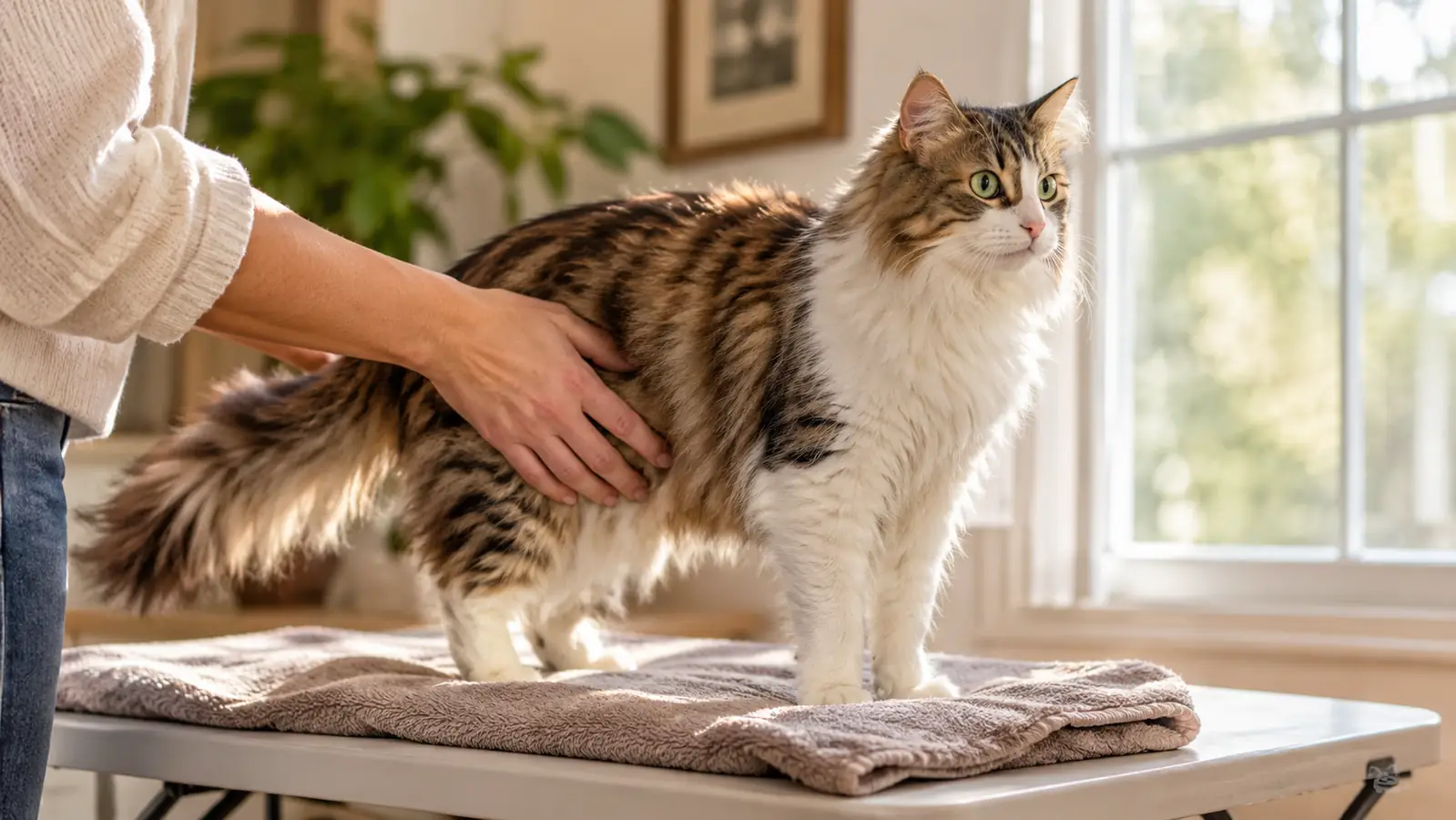
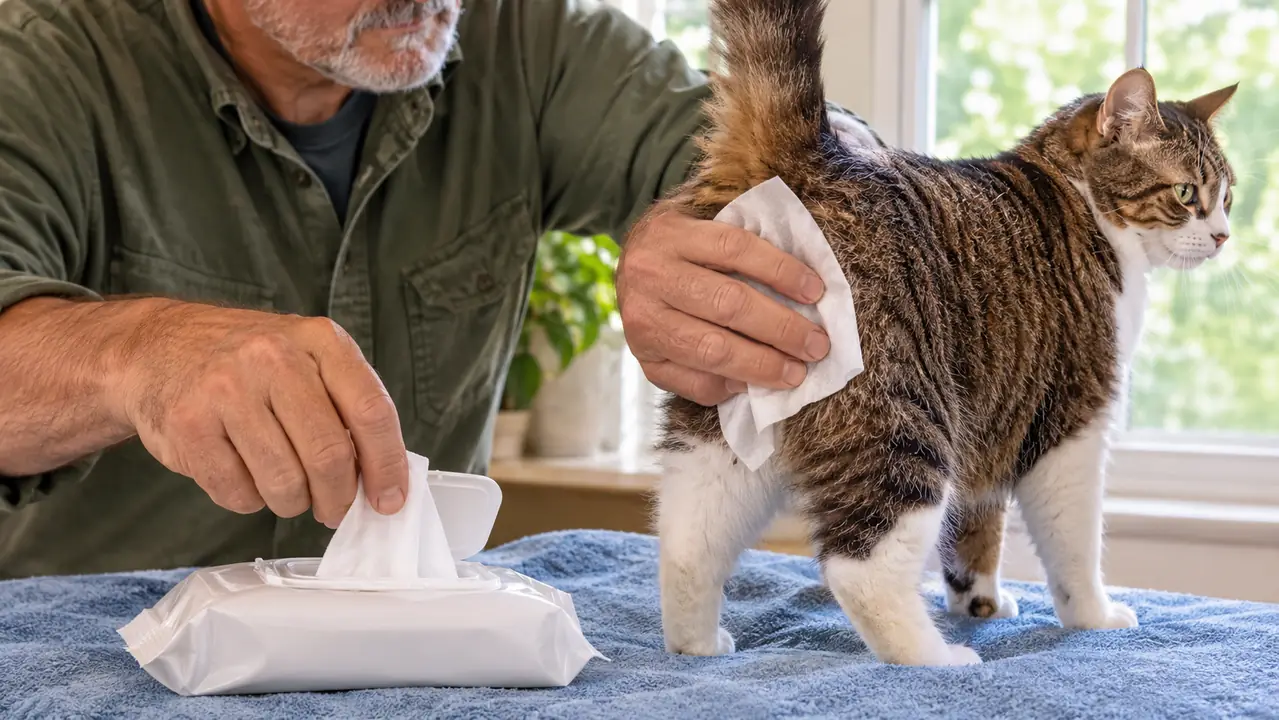
Juniper is 7, about 14 pounds, smoky gray, and she sheds like a small weather system. She gets mats behind her ears and on her back legs, and she tolerates brushing only if it is short and ends on her terms. The wipes are not part of her mat routine at all, and I want to be blunt about that, because a wet wipe on a tight mat does nothing except make the mat damp and slightly tighter when it dries. Where they earn their keep with her is the hindquarters. She gets a little grubby back there, and a wipe handles it in about twenty seconds without the comb, the slicker brush, or the negotiation that comes with either one.
The first time I used one on her, in the second week of March, I made the mistake of starting at the tail end. She was off the towel and under the bed before I got a second stroke in, and it took ten minutes and a treat to coax her back out. Starting at the shoulders and working back has not lost her once since. That is a small thing that took me a week to learn, and it cost me a handful of wipes I could have used elsewhere.
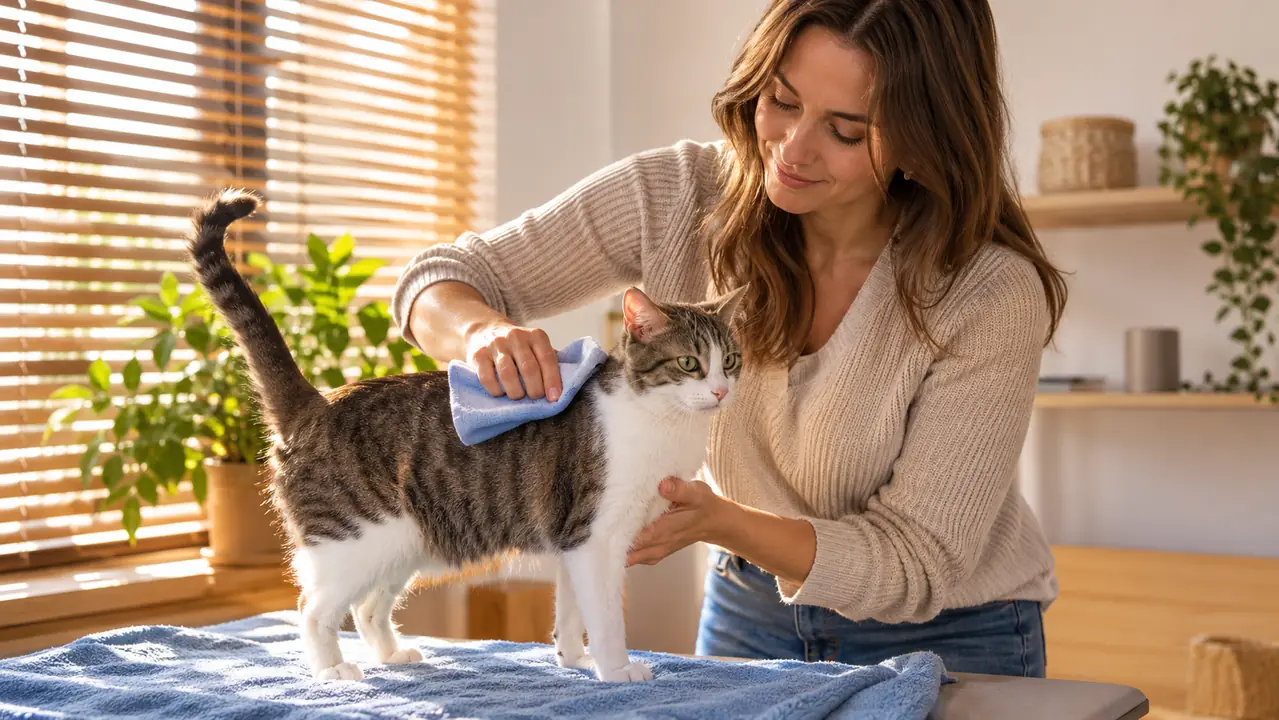
Pip is 4, a short-haired orange tabby, about 9 pounds, and he fights nail trims and hates baths with equal commitment. He does not love being wiped either, but he will tolerate it if I start at the shoulders and work back while he is half asleep on the towel. The directions say to wipe from the back of the ears to the tail and avoid the eyes, and that order genuinely matters. Working against the lie of the coat gets a complaint and a tail flick. Working with it gets me all the way to the tail without a fuss. I also do not chase him around the room. If he gets up, we are done, and that has been the rule with both cats since the first week.
The allergy visits are where these have quietly become part of the weekly routine instead of a special occasion tool. Twenty minutes before my sister arrives, I go over both coats with one wipe each, then do the cushion where Juniper sleeps. It is not an eraser for allergens and I would never tell her it is. What it does is lift the loose dander off the surface of the coat so it is not going into the air the moment someone sits down on the couch. On the first visit after I bought them, in mid-March, I used three wipes in total: two on Juniper because her coat is dense, one on Pip, then the same wipe flipped over on that cushion. My sister sat on the couch for most of an afternoon and did not reach for a tissue until she was in the car. I am not going to claim the wipes did all of that. Her antihistamine was already doing its job. But the air in that room was different, and it has been every visit since. She still takes the tablet. She sneezes less. That is the whole honest claim, and it is enough for me.
A wet wipe on a tight mat does nothing except make the mat damp. The win is the twenty seconds at the hindquarters, not the fight with the comb.
What Is Actually in Them, and What Isn't
Each wipe carries colloidal oat flour, which is the skin-soothing part, and honey, which Burt's Bees uses to condition the coat and help maintain pH balance. The rest of the story is what is missing from the formula. No fragrances. No sulfates. No colorants. No harsh chemicals. For a cat who grooms herself constantly and then swallows whatever is sitting on her coat, that list matters more than any of the copy printed around it. I read this label the same way I used to read the back of a serum for a customer who wanted to know what she was putting on her face, and it holds up. An unscented wipe means my cat does not spend the next hour making a face at me.
I know that because of what I tried first, in February, before these. I bought a foaming waterless shampoo on a whim, the kind you work through the coat with a cloth and leave on rather than rinse. It cleaned well enough and it made the spare room smell like a hotel lobby for two days. Pip went under the guest bed and skipped dinner. That is less a knock on the foam than a note on how much a scent registers with a cat, and it is the reason the unscented line on the Burt's Bees pack was the deciding factor for me rather than a nice extra.
What is not in the formula is anything that breaks down oil or lifts a stain. If your cat has gotten into something greasy, a wipe will spread it into a wider, thinner, greasy patch, and you will both be annoyed. That is not really a flaw. It is a tool doing a different job than the one you wanted it to do. For everyday dust, loose dander, litter grit on the back paws, and general coat freshening, it works. For anything with a smell or a grease component, you need a bath or a vet, and no wipe on the shelf changes that.
What I Liked
- Unscented and made without fragrances, sulfates or colorants, which matters on a cat who grooms herself all day
- Colloidal oat flour and honey in the formula, so it is doing more than wetting the coat
- Each wipe measures 6.8 by 7 inches, enough for one full pass from back of the ears to tail on a small cat
- Fast enough to use a few times a week without turning grooming into an event
- Replaced most of the baths in my house, which is the outcome I actually wanted
Where It Falls Short
- Does nothing for mats, and a damp mat feels tighter once it dries
- The flat pack has to be held or weighted down while you pull a wipe out
- Two wipes per session on a long-haired cat, so a 50-count pack goes faster than the listing implies
- No help at all with grease, odor, or anything stuck into the coat
- A cat who will not be handled will still not be handled
The Bath Question
People ask whether these can replace a bath, and the honest answer is that they replace the baths you were taking for cosmetic reasons, not the ones you take because the cat needs one. In my house, baths are rare and happen only when something has gone wrong. Before these wipes, I was washing a cat roughly once a month out of a vague sense that they were due. Since March I have filled the sink exactly twice. Once for Pip in late April, after he rolled in something in the backyard I still cannot identify, and once for Juniper after a muddy week across her back legs. Neither was optional and no wipe would have touched either one. Everything else since March has been a wipe and a brush, and the sink has stayed dry.
Where they cannot substitute is water. A bath gets down to the skin and rinses the coat. A wipe moves the top layer around and leaves a trace of oat flour and honey behind, which is fine and even pleasant on a coat that was already clean. On a coat that is genuinely dirty, you are polishing dirt. If your cat screams through a bath, though, this is a reasonable compromise for most weeks of the year, and that alone justifies the shelf space.
Where They Fall Short
The mats are the big one, so I will say it plainly. Juniper grows them behind her ears every few weeks, and I tried a wipe on a fresh one out of curiosity. It dampened the surface and made the mat feel tighter when it dried. That was in early April, on a small mat behind her right ear, maybe the size of a pea. I already had a wipe in my hand from a hindquarter pass and figured it was worth one experiment. It was not. The mat dried into something harder than it started, and I ended up working it loose with my fingers the next evening anyway, which is the twenty minutes I had been trying to avoid. For an actual mat, fingers first, then the slicker brush, and only after that does a wipe come out to clean up the coat underneath. If you are buying these specifically to skip that sequence, they will not help you.
The second limitation is the cat, not the wipe. Pip will not sit for a brush, and he does not really sit for a wipe either. I started using a grooming glove on him about five weeks ago for exactly this reason and it goes better, because he reads the glove as petting and the wipe as handling. On him the wipe is a two-hand job, one hand steadying at the shoulders and one doing the pass. If your cat will not be touched at all, no wipe solves that, and any review promising otherwise is describing a different cat than the one in your house.
The third is arithmetic, which is unglamorous and the thing I most wanted to know before I bought. Fifty wipes in a pack. A long-haired cat who needs two per session at three sessions a week is six wipes a week, which is about eight weeks if you use the pack for nothing else. Add a second cat, add the couch cushion, add the allergy visits before my sister comes over, and my real number lands at three to four weeks per pack. I would rather hand you that number than let you assume a pack lasts a season and get surprised in the middle of a grooming session.
Who This Is For
These are for the owner whose cat is basically clean and needs maintenance, not rescue. If your cat has a healthy coat, no mats, and you want to cut down the loose dander before guests arrive, or keep the hindquarters respectable between baths, this is the least dramatic tool I have found, and I have tried the ones that make loud promises. It is also for any house with a fragrance sensitivity in it, human or feline, because the unscented formula is the reason I stayed with Burt's Bees after that foaming bottle went in the bin.
It also suits a cat who will tolerate about twenty seconds of handling. Juniper and Pip are both in that category, one easily and one with patience and a treat afterward. If you already brush most evenings, the wipe slots in after the brush as a finish, not instead of it.
Who Should Skip It
Skip these if you are shopping for a mat remover, because they are not one. Skip them if your cat has an irritated or flaky patch on the skin, because a wipe is not a treatment and a vet is. Skip them if your only goal is a bath replacement for a genuinely dirty cat, because a wipe on a greasy coat just relocates the grease. And skip them if your cat will not be handled, because this is a handling tool before it is a cleaning tool, and that single fact decides whether it works in your house or sits in a drawer.
One more piece of honesty before the button. If you are still comparing, I wrote a longer piece on what six months of use looks like and a head-to-head against a waterless foam option, and both are worth ten minutes if you are undecided. But if you already know you want a fragrance-free wipe for spot cleaning and dander, you have the whole picture here: what it fixes, what it does not, and what a pack actually lasts. The rest is just clicking.
Buy it for dander and everyday grime. Not for mats.
This is the pack I reorder, with every caveat above still attached. If your cat tolerates twenty seconds of handling and needs the coat freshened between baths, it earns its place in the craft table drawer.
Amazon Check Today's Price on Amazon →